
Mother Talk
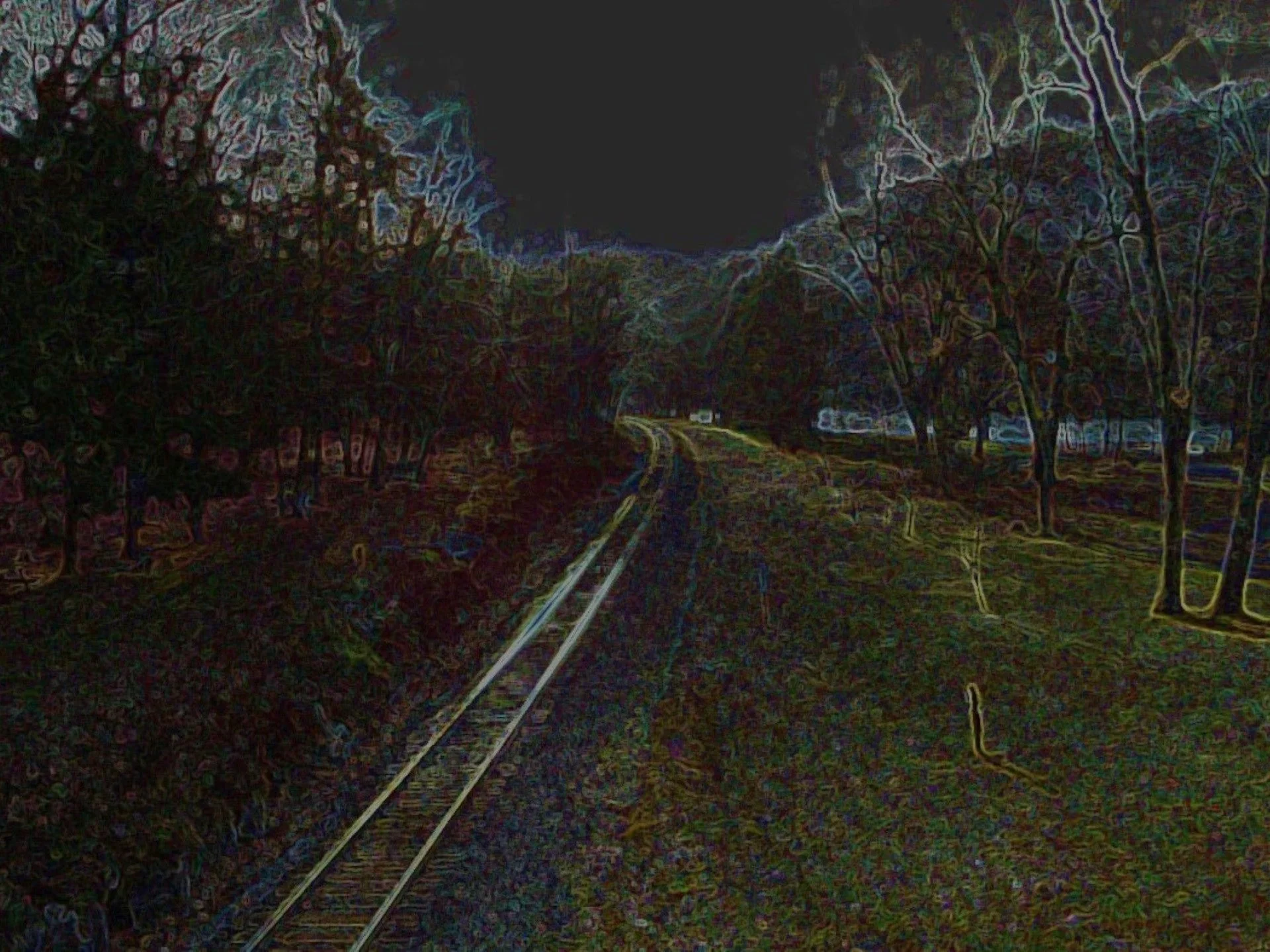
"Around the Riverbend” by David Summerfield (originally published in The Words Faire Literary Magazine)
The first time it happens, they’re in the pharmacy. Cass won’t turn twenty-one until the following February, so she must pass the bottle of pink cough syrup across the aisle for Vivian to buy on her behalf. With it is a crumpled wad of cash, which she knows will go unspent. When they’re together, Cass never pays. She lingers by the register while Vivian removes thin bills from her own wallet. You two make me sick you’re so pretty, the cashier comments brightly from behind the counter. He is a plump man approaching middle age. Vivian doesn’t say anything, but a thin smile reaches her face. She places the money on the table. In the fluorescents, her hair looks slick, like mud. You must come from a great family, he continues, such a pretty mother and daughter. Here, Vivian laughs. She doesn’t correct him. He hands her the bottle, along with her change. Vivian turns to find Cass at her elbow. They won’t talk about it until they’re back in the car, and then they will only laugh. It’s their third date.
Later, as the silver Nissan winds its way through the foothills, Cass looks at her reflection in the side mirror and searches, as she has before, for any trace of Vivian. They look alike in the sense that everyone does. Their eyes are the same distance apart, tilted at roughly the same angle, irises milky blue. Under pale skin they have strong cheekbones and faces that culminate in swollen, purplish lips. Yet they resemble each other only when side by side, only in context. It is a basic principle of art: people will find faces in anything—an outlet, the headlights of a car, a loaf of ciabatta. Confronted with two humans—two women, much less—of course there are similarities. But this thought gives Cass no comfort.
You know, Vivian is saying, this road used to be a mountain. They chiseled it out with dynamite to make way for train tracks to import Coca Cola. There was supposed to be a railroad. But Coke didn’t stay here. They went down south instead.
South?
Georgia, Vivian explains, and gives a gesture with her hands like oh, well.
Is that true? Cass asks her. Vivian nods.
This tangent is typical of Vivian. She is clever, but she treats her own intellect with a kind of wry disdain. She discusses history and science with great authority, but when asked to elaborate, she is elusive. She spares her listener only a few brief sentences, then, reaching the end of a point, raises her hands to suggest, with a touch of irony, that she in fact knows nothing. It is in this false humility that Cass finds most attractive.
Cass watches the passing stone in silence. In the passenger seat, one of her legs is folded by her chest. She brings the cough syrup to her lips. You know, she mumbles, my mom used to crush up Quaaludes and put it in this stuff. She called it her special drink.
False?
Cass nods. She doesn’t remember when they started playing this game, but it’s since become a regular fixture of their conversations. One of them, with a cigarette between her lips—or, in this case, a mouthful of medicine—will present an anecdote from her past life. The other will have to guess: true or false? There’s a challenge to it Cass likes, but it also reminds her of just how little they know about each other. She doesn’t know, for example, Vivian’s middle name, or her hometown, cities she has lived in or how long she was in each. She doesn’t know if she has ever been married, or what shape her private life took before they met. She knows, from a thin silver scar that curves along Vivian’s belly, that there was a child, at least once. Its shape is symmetrical, a thin twin on the other side. Cass had traced them with her fingers when they went to bed the first time, attempting tenderness, but wasn’t bold enough to ask Vivian about their origin. Despite her ignorance, she doesn’t want to know anything more about her. She’d rather fill in the details for herself.
When they reach Cass’s apartment, the car slows, comes to a quiet stop. They do not kiss goodbye.
***
Her life before was simple, unspooling in predictable sequence. Lacking any measurable aptitudes, she dropped out of high school, took odd jobs and on the weekend sedated herself heavily, every action becoming blurred and thus plausible. She would rationalize her decisions in the morning with the knowledge that she had been drunk, though many of those same choices she would’ve made sober. It was on one of those nights she met Vivian.
She was sitting in the middle-seat of a truck, wedged between driver and passenger. The sterile perfume of air freshener and a human scent, closer to rot than odor, clung to the fuzzy dashboard. Her companions were coworkers more than friends—though they may have been the closest thing she had—older girls who worked with her at the filling station, pumping gas and selling beer to truckers. They still had the day’s grease on their hands, a yellow sheen that never fully washed off. Cass had a variety of lies she told people who asked her about the stain: that she was a painter or sculptor, that it was a birthmark she’d been born with, or even guts from big game she hunted. All were more glamorous than the truth.
In the dark party, she was stopped in the kitchen by a profession of hands and cloth. She was drunk enough that it took her several seconds to realize it was a man. He whispered in her ear, rambling lines about attraction to her supposed beauty, about his job and his car. His words were indecipherable to her. She pushed away and found her friends in the corner. They had their small silver knives out, cutting holes in beer cans to drink them in one go. I want to get out, she said, and they had all laughed at her in the predictable, monotone way she was accustomed to. They ridiculed her sometimes for her youth, chided her for her moroseness, but they were still the best option she had, the only gateway to the mysterious and adult life that lay in dark rooms like this, filled with smoke and the roar of bands she didn’t know. I want to leave, she said again, and this time they listened.
Back in the pickup, the billboards flicking by them on the highway in blurred primary colors. Several moments passed before Cass realized the girls were talking, several more before she knew it was about her. We’re going to leave you here, okay? the driver was saying. The tilted red sign of the filling station came into focus. Cass began to protest, but there was no room for argument. Before she knew it she was on the curb, the truck speeding away from her. A brittle autumn wind caught her, and she pulled her shirt closer.
The attendants working inside weren’t ones she knew. She idled by the counter, relishing the fact that she was just another customer. She hid her stained hands in her sleeves, so the tips of her fingers appeared only as yellow nubs, candles yet to be lit. She circled the counter until she stopped in front of the cigarettes. They were stacked in neat rows, their colorful packaging beckoning her. On each, a little message, varying by brand but alike in enthusiasm: make your day, try Newports! For a load of fun, try a Camel! It’s toasted! The positivity of the boxes amused her, and she found herself picking one up, shaking it to hear the noise like a child rattling a present before Christmas. She put it up to her nose and smelled it, then put it back down, fingers sliding off the plastic.
From behind her, she heard: are you going to buy that, or keep staring at it?
Cass turned, half-expecting to see a uniformed employee prepared to tell her off. Instead she found a woman. She was wearing black, hair the same color. A stack of magazines was clutched against her hip. Head tilted one way, she assessed Cass, the reverberation of her voice still and beautiful. Cass guessed that she was about twice her age, and rich, yet it was not money the woman seemed to possess most, but calmness. Cass wasn’t old enough to know the two were the same.
Excuse me? she replied.
And do you smoke, regularly?
No. I mean, sometimes. Occasionally.
Cass felt herself mumbling and she forced her tongue to silence. She was aware now of the distance between them, which was not as much as it should be; if she reached out, they would converge before her arm was fully extended. She stepped back.
Now I’ve scared you, the woman said, with that same quizzical look.
No.
I didn’t mean to. I was just curious. It’s been a long time since I bought cigarettes myself, and I was just wondering what compels someone to. You know, what goes through the mind. I’ve forgotten.
Cass frowned. I don’t know, she responded. I guess I just wanted some.
Then why don’t you buy them? the woman asked, and for the first time a smile broke her lips. Her teeth were white.
Cass looked at the counter, then at the box in her hand. She had just turned twenty. Clearly the woman knew this, or suspected, and so she issued a challenge: try to buy the thing you cannot buy, and get caught for it. Or the other option: put it back on its shelf, admit you’re too young. Both embarrassing, each in their own way. Finally, after letting Cass rest in this discomfort for a few seconds, the woman approached, and, extending her thin wrist, picked up a pack and balanced it on top of her magazines. Cass heard the bright click of her shoes as she went over to the counter, then the ring of the bell as she left the store.
In the lot, she was leaning against the hood of her Nissan. Its silver body glittered in the store’s light. I’m Vivian, she said.
Cass.
Come have a cigarette with me. Come on, I know you want one.
Cass rubbed her arms together. She could feel hair she hadn’t shaved, short and bristled in the cold. She looked beyond Vivian, into the green bushes behind her. Past that were barns, fields of corn and wheat. In the sun they would shine yellow. On the highway, distant noise of traffic. She walked over to the car.
Here, Vivian said, and proffered a white stem from the box. Cass placed it on her tongue.
You’ve never done this before, Vivian was saying. No, it’s fine. I hadn’t at your age. Here, take a breath. Inhale a little. No, not that deep. It’s not a milkshake. There, there you go. Now blow it away. There you are. Come sit down.
Cass sat on the hood next to Vivian. She crossed her legs, then uncrossed them, then wished there was some third option between the two: half-crossed, perhaps. She attempted and abandoned this. So, she said after a while, you live around here?
Laverne.
Oh. That’s a little bit of a drive.
The spate of small talk dissipated. On one of the far-off farms, there was a flick of orange, then a brighter glow. Cass leaned forward, trying to see what it was. They’re burning the wood, Vivian said. It’s infested.
Infested?
Bugs. If you don’t purge it, it’ll spread.
Cass nodded. She brought the cigarette back up to her lips, but its tip was extinguished. Vivian handed her the lighter. Cass fumbled around with it, the mechanism eluding her. She reached out a hand to touch Vivian’s shoulder, but paused. Asking her to light it again would be too much of an embarrassment, so she held it by her side instead, unburnt, like a single white bone.
You know, Vivian said, you have a problem.
Sorry?
You have a problem. I can tell.
Don’t give me that Al-Anon shit. Just because I’m drunk doesn’t make me an alcoholic.
Vivian frowned. I didn’t say you were. I said you had a problem. We all do. The sooner you discover yours, the sooner you can fix it.
The logic of this statement was basic yet unavoidable, and Cass found herself unable to argue.
After a while she thought to ask: then what’s yours?
I don’t know mine yet, Vivian replied simply. If I did, I wouldn’t be here.
She stubbed out her cigarette on the concrete. Cass set hers down, unsmoked. In the distance, the fire kept burning. There was nothing else for it to do.
***
They progressed to the car simply. Vivian opened the back door instead of the front. Lying down on the cold leather seat, Cass thought, briefly, this is the strangest thing I’ve ever done, but by that point Vivian’s lips had reached her neck. She thought, I’m going to bed with a woman the age of my own mother, but that was not as good of a deterrent as she thought it would be, and her pants came off all the same. Only when the momentum of their bodies rotated them, so Cass could see, from her crouched position, a sliver of the outside world through the windshield, did she think of the future.
The next day, there was a message from Vivian on her machine. After the night they’d had, her voice seemed small, words unable to fill up the character she created previously. I enjoyed yesterday, she was saying, and I hope you did as well. I want to see you again, if that’s alright? Cass had the phone in one hand and with the other she pressed her wrist to her nose, searching the taut skin for Vivian’s perfume. All she smelled was sweat.
***
The brush cuts through her hair like a knife. Vivian’s hand tilts her chin to the sky. It’s six weeks since they’ve met, and four times they’ve been mistaken for mother and daughter. Once at the pharmacy, then twice at restaurants, and again at a theatre. Or at least, four times someone’s commented on it. Cass’s life has focused, narrowed; she spends her time in a rotation between work, sleep, Vivian. Often the three overlap. She has fallen out of touch with her friends since the party, and has no one left to ask if their arrangement is normal.
She’s sitting in a lawn chair on a clear blue day. Dusk approaches. She can smell vegetables cooking inside. She arrived at Vivian’s townhouse an hour early for the dinner party, but her appearance was found to be unsatisfactorily feminine, and Vivian is now fixing it, with swift, certain strokes: makeup then brush, then makeup again, until Cass’s hair falls in soft waves around blushed cheeks. When she is at last finished, she puts the brush down on the arm of the chair and rolls her sleeves down. Vivian? Cass says, her voice breaking slightly. Vivian makes a small noise in response. Does it ever strike you as weird, what we’re doing?
Vivian sighs. What, having dinner?
No. Like this, you and me. I mean, not you and me, but us. The other day, in the diner, for example, the waitress thought you were my mother—she didn’t say it, but I could just tell. I mean, she gave you the bill, didn’t even ask if we wanted to split it–
Cass.
And the gas station guy? He thought that too. And we don’t even look that much alike, so why would anyone say that?
Cass.
Yes? Cass replies, and at last she turns to look at Vivian. In the golden light, Vivian’s features are softer, blurred. Her two blue eyes become one. The worry that grips Cass now is that she will age into this face, that one day in her adulthood she will look in the mirror and see Vivian, that she has been chasing herself all along. But this is a far-off fear, and meaningless to her daily life.
Let’s quit with all this mother talk, Vivian says. The brush sits face-up. Minutes split into seconds, then into something smaller. If you don’t purge it, it’ll spread, Cass thinks, but she doesn’t say this part aloud.
***
She hovers in the kitchen for most of the party. The glass of wine that Vivian periodically refills for her does little to get her drunk, but brings her instead to a nausea that feels vaguely adult. The guests huddle in twos and threes around the room, creating a dull murmur of conversation. They are middle-aged and bespectacled, possessing the garb of academia if not the degrees. Cass realizes that she has no idea how Vivian has even met them. Hours of the party pass before any of them speak to Cass, and when one does it is just a small bearded man who introduces himself as Wallace, shaking her hand limply. Vivian is behind him, chiding Cass for her shyness.
She’s wilting in a corner. Come on, come over here.
So how did you two meet? Wallace asks.
Cass wanted a cigarette, Vivian says. Cass laughs at this. It is such a simple way to put it.
Vivian moves around Cass, and puts a wrist over her waist. Wallace lingers in front of them, assessing Cass blankly. You know, he says, I’ve been friends with Vivian a long time, and I’ve never seen her like this with anyone. Vivian smiles. Cass wonders if this is a practiced line, if perhaps the two of them discussed it before the party. She can imagine Vivian intoning these same words, making Wallace repeat them until his pronunciation is perfect. She nods mutely.
There’s not a woman smarter anywhere in the world, Wallace says, but even Cass knows this isn’t true. Vivian said it herself: if she’s so smart, then why is she here? The relics of her life are mundane and unspecial: the gabled townhouse, a collection of gold jewelry, the two silver scars that split her stomach. If she’s so smart, then why did they meet at a filling station where she was buying trashy magazines? Why not a library? But Cass would not be caught dead in a place like that. What she expects of others she cannot be herself. She takes another sip of the wine, but this time its taste is too bitter to swallow. She lets it seep back into the glass from the corners of her small mouth. Vivian brings to her lips Cass’s yellow hand.
Later, clad in one of Vivian’s thick cable knit sweaters, Cass will take her glasses off and place them on the edge of the bed, and the shape of her lover in the doorway will be only a blur. She will hear her own voice as only syllables, too true to be words.
I love people too much. I love this too much. That’s my problem.
That’s not a problem, Vivian will reply.
Cass won’t know which of them is lying.
***
In the diner, they sit side by side, staring at the food in front of them like an audience at a show. Cass moves an egg across her plate, an actor across a stage. She’s wearing her work uniform, hair caught up in a tight bun. Outside, the clouds whisper threat of storm.
True or false? Vivian is saying. Cass can’t remember what she’s referring to.
I don’t want to play that game right now.
Vivian lays her fork on the table. She laces her fingers together, one over the other. She returns to silence.
Cass fantasizes about a conversation they could have, the two of them. What would you think if we stopped this? she would say.
At first, Vivian might feign ignorance. Stop what?
Cass would rephrase: I don’t think it’s such a good idea that we see each other anymore.
And Vivian will nod and smile with her white teeth. She would stand up, leaving green bills on the table for the waiter who thinks she is a mother, who won’t understand why the daughter will keep sitting at the table crying as the food gets cold, why she will eventually get up and go to the phone booth, calling through tears for her mother to come back.
After all, it is she who needs Vivian, not the other way around. What is her life without her? A job, an apartment, green fields she’ll drive past. Highways she’ll never take. The riveting sin that follows her around whenever she’s with Vivian would disappear.
Cass doesn’t speak. Thunder rumbles in the distance, behind brown hills. She pushes her plate away.
Off to work? Vivian asks.
Cass nods.
You won’t want a ride then?
I’ll take the bus, Cass says.
She gets up and goes to the door. She spares Vivian a single glance, but finds her dark hair only, a shade over her features. Her eyes are focused on her plate. Cass wants to go to her, to hold her and to kiss her, to rebuke her, to desire her and taste her and hate her, to let her know everything. But she won’t. There’s no need to say goodbye. They’ll see each other tonight.
Cass touches the handle. Outside of this place is a road, and beyond that cities, mountains to climb and rivers to swim, green grass to lie in at the end of warm days—outside of the diner is the rest of her life. And yet she pauses before she reaches the exit.
She waits at the bus station. With every passing car comes another stranger. In the hot rain they cannot see her face.
About the Author
Camille Pirtle is a writer based in New York. Her fiction and non-fiction have appeared nationally in The Battering Ram Review, as well as in local publications such as The Crucible and Expression in her native Chicago. She contributes to Hoot Magazine and attends Columbia University, where she studies English Literature.
about the artist
David Summerfield is a graduate of Frostburg State University, Maryland, and a veteran of the Iraq war. He has been an editor, columnist, and contributor to various publications within his home state of West Virginia.