
URGENT: New Home Needed
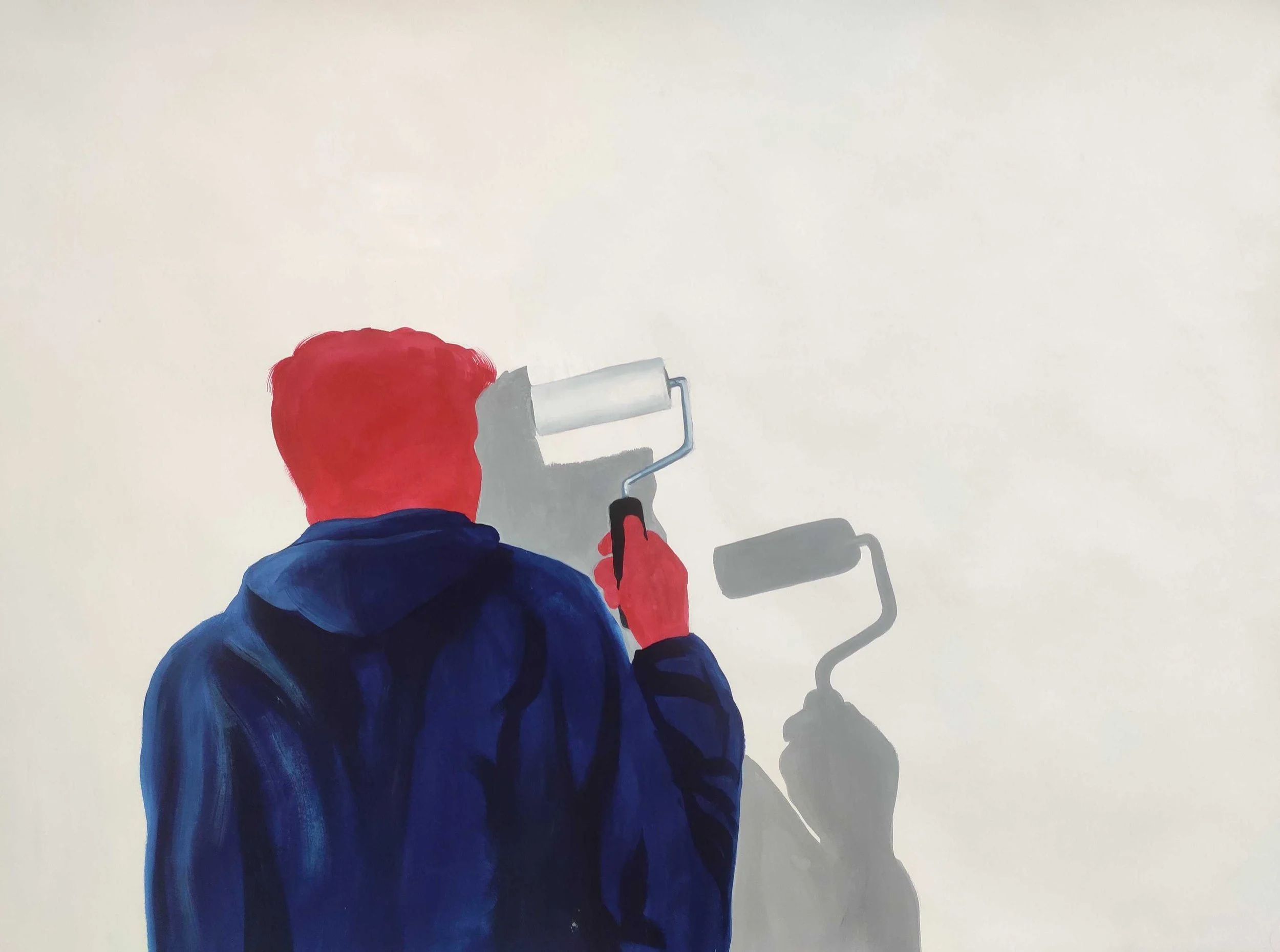
“Atleast Once A Year” by Shanmukh Gollu
Emil doesn’t like the apartment. Yes, it’s a downgrade from my mother’s ranch in Montana, but I didn’t expect him to be quite so sulky. He eyes the second-hand coffee pot with suspicion; he touches tentative fingertips to the dust on each window blind; he sits on the edge of the couch as if the loose brown cushions might attack.
It’s not a nice apartment, I know. A studio: living room is kitchen is bedroom is entryway. Only the bathroom offers a little privacy, but it is so small that Emil’s yardstick limbs cram horribly. I’d upgrade, but the money from selling the ranch hasn’t come in yet and there’s no point. I’m leaving Tuscaloosa soon. I just need to find somewhere for Emil to stay.
At night, with summer bleeding into autumn and the weather still warm, Emil steps out onto the two-foot space I call the balcony and watches the moon. I say ‘watch’ because I think he expects something—maybe a slice of moon to drift into his hands, sweet like melon, waxy like cheese. I don’t feed him enough.
The term “Chinese vampire” is actually a misnomer. Technically, Chinese vampires are more like zombies. I’m not sure who decided on “vampire” instead of “zombie” for the English translation, but the Mandarin word for Emil’s kind is “jiang shi,” literally meaning “stiff corpse.” Perhaps the translator was a historian. I attended a History of Vampirism and Eastern Magic speaker event at the University of Alabama when my mother passed, when I was left with Emil. The lecturer explained that the Romanians were the first to practice raising magic; their creatures were “more” vampiric in the sense that they had pale skin, red mouths, and a dependency on blood. In their wake, I guess every creature that was raised instead of born was termed vampire, at least in Western vernacular.
It was from my mother that I learned of crossbreeds. I remember her sitting with Emil, her hair swept to one side, musing as to his origins while he siphoned blood from the back of her neck. She preferred the back of the neck because it was easiest to hide, bite marks vanishing beneath high collars, turtlenecks, well-placed curls. Emil is a Chinese vampire in most ways, but he must have some Romanian magic. Otherwise he wouldn’t need blood like this, like a vampire bat! And she made hooks with her index fingers and placed them over her mouth, like big teeth. I was young, giggling and shrinking away.
When Emil comes in from the balcony, he shuts the sliding door gently behind him. Usually it is past midnight, and usually I am lying awake in bed. In the darkness, he is a lanky silhouette with slumped shoulders and a feathery plume of hair. My apartment smells like the perfume my mother used to spray on him, the one he still sprays on himself. I think he is unhappy; he moves sluggishly, first to my side, where he pauses, brief; then to the kitchenette where he likes to lurk. I roll to the wall. I’ve lived alone for years now and it is unsettling to share space again. I am too aware of the molecular shift in Emil’s wake.
***
Emil needs a tablespoon of blood a day. He can go up to a week without drinking, but after that he starts stiffening, the vampire approximation of rigor mortis setting in. My mother sat me down when I turned fourteen and ran me through Emil’s care routine. I’d just gotten my first cell phone and that also meant I was to be added to Emil’s “emergency contacts,” or the list of phone numbers he wore around his neck on a dog tag.
“He’s not my pet,” I said. “I don’t understand why I have to be responsible for him.”
“You don’t care for Emil? You don’t want him to be safe?”
I sighed. “Obviously I want him to be safe. But he’s yours. I’ve got too much going on—”
“It’s just for emergency contact! No one will ever use it. It’s for in case something happens to me.”
A tablespoon of blood a day, human or animal. Rigor mortis. A list of modern-day objects to avoid: mirrors, sunlight, bells. What sort of grooming products he likes, what music he can’t listen to. I didn’t take notes but I should have. That was probably one of the last conversations I had with my mother when she fully felt like my mother, both the adult I lived with and the one who taught me things about the world.
We weren’t very similar, my mother and I. For one, she grew up in China. Back then, back there, every good family had a vampire. Security that never slept, that was how the peddlers advertised them. Ghastly in appearance and excellent for scaring away house burglars, with their grave-gray skin, blue-veined fingers, and vacant eyes. Plus, easy to control: if you tired of them, they came with an enchanted slip of paper. Press it to their foreheads and they returned to the grave! My mother grew up with her politician father’s small army of vampires, and she was so thrilled to discover that they were obtainable in America.
Of course, Emil was not quite what she imagined. The first person he bit was me, when I was rifling through my mother’s closet. She’d stationed him in her room, conscious at least that I would need time to get used to him before he wandered the house. I wouldn’t have ventured in except I urgently needed a pink scarf for Valentine’s Day—things like that mattered in elementary school, in Montana, to children who looked different like me. As I reached for the scarf box on the top shelf, I felt fingers around my left arm and then a sharp prick to my wrist, and I screamed. I was crying and crying when my mother found me in the hallway, the bedroom door ajar behind me, Emil still inside. I asked her how soon I would begin turning into a vampire, and she told me that was just silly, Emil didn’t have rabies or anything and besides, vampires were raised by magic. It wasn’t some disease.
My mother did apologize profusely for the incident, blaming herself for not confirming Emil’s diet with his last family. But now that she had a bloodsucking vampire, she had uses for him. No better place than the West for a bloodsucker. Better than any chemical skin lightener, even though her skin was already lighter than many of the sun-spotted farmers who were our neighbors. It was just how it was done, my mother told me. In her childhood, girls were scolded for spending more than thirty minutes outside. I was lucky that my world now fussed over how skin color “wasn’t important,” but my mother stood by the story of how she’d met my father. He was studying abroad in Beijing and had attended a wedding, and he’d approached my mother at the reception because, from the back, with only her smooth arms and the pearly swathes of her shoulder blades to judge, he’d thought she was American, too.
I stayed away from Emil. He disgusted me. Beyond that, my mother’s use of him felt disgusting. It was so primitive, so carnal. Flesh and fluid and teeth and taste. She could dress him in button-downs and slacks, comb his hair and cut his fingernails, but he was still dead. He was still feeding from her. He was like the herbal medicine in the drawer, or the faux jade jewelry. I wished my mother had left vampires behind.
***
I check Craigslist. Maybe not the smartest avenue for rehoming a vampire, but I’m not a local, no network, no connections, and I had a decent experience selling a mini fridge last year. I posted an ad for Emil that’s been up for about a week now. A user named A_vampir3sRULE has responded with an offer. I tell him to meet me at the Starbucks off of Skyland Boulevard. The fact that I’m not from the Tuscaloosa area is immediately apparent: this is not a sip-and-chat Starbucks, this is a drive-thru and pick-up Starbucks, and the indoor seating is so limited that we end up leaning against our cars in the parking lot.
His name is Anderson. He’s thirty years old and working towards a PhD at the University of Alabama. He’s studying vampiric breeds and is disappointed that I know nothing of Emil except the surname of his last family. I’m disappointed that he’s a dud.
“I have to go,” I say.
“Whoa whoa whoa,” he counters, “My folks might know some folks looking for security. He can do that, right? Or, you know, a Halloween thing. That’s coming up.”
Emil working a haunted house. I almost snort.
“Seriously. I want to help you find a good place for him. Here, let’s meet again, once I can gather some information. Maybe at night, you could bring him—”
I pull my keys out of my purse. “It was nice to meet you.”
***
There was a month when I was a teenager, maybe fifteen or sixteen years old. I was obsessed with who Emil might have been when he was alive. A soldier? A street thief? A youngest son of little importance whose body was dug up without complaint? From appearance alone, I theorized that he’d died sometime in his late twenties or early thirties, and from research in the library, he’d likely died from disease or war. I was afraid to check for battle wounds with my mother around, so I waited until she was out shopping to approach.
Emil sat at the kitchen table, stretching a rubber band and then easing the tension, again and again. I stood for a minute in the doorway, watching. The blinds were drawn because vampires are not good in daylight, but a soft glow filtered through. Dust floated in brigh patches; the hardwood floor and marble countertops and varnished cabinets glistened in the dimmer corners. It looked like the set of a movie, the one where the woman comes home and everything is a hazy Sunday afternoon except for the husband or father or son who has to tell her that he lost his job or started drinking again. I felt a surge of feeling for Emil, but I couldn’t name it. Sympathy? Pity? Sorrow?
I walked to him. My original plan was to lift up his shirt and quickly check whether there were scars, but the moment weighed my hands down. He looked so lost, and listless. Maybe he was hungry? My mother had been quite busy the past couple of days; she was trying to sell an acre of our property to the neighbor and it wasn’t going well. I pulled up a chair across from him and snapped to get his attention.
“Hey,” I said. I tossed my hair over one shoulder and bared the back of my neck. “Drink.”
Immediately, I regretted it. What was I doing? Emil was motionless except for his fingers still pulling on the rubber band. He didn’t exactly have facial expressions, but I got the overwhelming sensation that he thought I was ridiculous, and suddenly I was determined. He was a pet, a servant, bound by my mother’s command. He listened to me.
“Drink,” I repeated. “Come on.”
A long silence. Finally, he eased forward, as if lag occurred between my instructions and his processing. Reluctance? Did I smell? Was there something in my blood that he didn’t like? My cheeks heated, but I set my jaw. To not even be good enough for a vampire to drink from—
He bit.
It didn’t really hurt, not as much as I thought it would, although I might have been in shock. It was over in ten seconds. I slapped a hand over the puncture wounds to keep blood from staining my shirt. The whole procedure felt clinical.
I gave Emil an awkward nod. “Uh. Thanks.” Why was I thanking him? “Um. Don’t tell my mom?” How would he have told my mother? He couldn’t speak.
Emil pushed to his feet and wandered into the living room. I was lightheaded. Any romanticization of the vampire in the kitchen had given way to complete embarrassment. And I hadn’t even looked for the war scars! I went to the bathroom and closed the door. I pressed toilet paper against my neck until it stopped bleeding, then sprayed hydrogen peroxide over the wound. I stared at myself in the mirror. I looked like I always did. My hair was too thin to gracefully sit atop my shoulders, but it tried. I had my father’s big nose but my mother’s high cheekbones. My skin was just my skin. If anything, it looked yellower, not whiter, but that could’ve just been the bathroom light.
Only afterwards did I feel queasy about the ordeal. I couldn’t believe that I had let it happen, that I’d asked for it. I spent the next week paranoid that my hair would shift and someone would scream, are those bite marks?! I was terrified my mother knew and that she would start having him drink from me regularly. For much longer than I care to admit, I couldn’t look Emil in the eye. I avoided the rooms he liked. My anxiety gradually dissipated to indifference, but I never sought him out again. And then I was away for college, and I barely had to see him at all. Only for those scant school vacations when I went home did we cross paths—a head nod from me, a blank stare from him.
***
The couple seem promising. This time I call first, and the lady speaks with a pleasant Southern twang. They’re not sure they would need Emil for cosmetic bloodletting—I didn’t even know people did that!—but they live in a less safe area and could use a watchdog. I ask to do a house check, and she is enthusiastic—of course, rehoming is scary, you gotta make sure you’re leaving him in good hands!
I take a day off of work, which isn’t difficult. Everyone is overly concerned when a woman’s mother dies. I drive the hour out to Sandra and Nick’s. They live in a predominantly Black neighborhood. That much is immediately apparent, and I remember Sandra’s words, less safe. I have the epiphany that Sandra and Nick might be racist and I should probably turn around, but she’s waving at me from a concrete stoop.
Both husband and wife are mid-forties, dull blond, orthodontic smiles. They walk me through the two story house, which smells like Lysol and some sort of breakfast food. Small talk is comfortable, and I’m starting to think they might be okay when we arrive at their bedroom. Large posters of vampires hang over the bed—looming black capes, drenched canines, women in torn lingerie, naked white throats. Sandra gives me a half-embarrassed shrug; Nick is unperturbed.
“Your ad mentioned cosmetic bloodletting,” Nick says. He glances at his wife, then lets out a breath. “We’re all adults here. Would Emil be okay with…” He bares his teeth in the suggestion of a bite. “Just once in a while. We, uh, like to keep it interesting.”
***
Since it concerns his fate, I recount the vampire sex couple to Emil. “See? You could have it a lot worse than me.”
Today he has taken an interest in a volume of Chinese poetry, flipping to a new page every five minutes. I don’t know if it is an aimless task or if he’s really trying to read. Can he read? I sit next to him on the couch. His gaze goes to my arm, which I splay before him. “C’mon. Drink.” Almost gingerly, he sinks a fang into the crook of my elbow. I resist the urge to grimace, refuse to contemplate the hygienics. It is not his fault. It is not his fault. I don’t watch the process. I spend enough time counting the row of bite scars I’ve collected, five now, one for every other day he’s been with me.
“We should get you a new source of blood,” I say. My voice comes out a little faint. “You don’t like drinking from me, I don’t like being drunk from.”
He finishes, wipes his mouth and stares at me. I used to be freaked out by his gray eyes, no pupils, when I lived in the Montana house, but everything is rendered soft by my worn apartment. Among the rogue pillows and scattered magazines, even Emil does not seem so out of place.
“So. How do you feel about a cat?”
***
A woman on Craigslist needs a cat sitter for two weeks. Timmy is fat and slow and purrs egregiously when his back is scratched. Emil has fed on cats before, strays my mother indulged around the ranch, but he dodges Timmy the way I dodged him as a child. I think he finds Timmy’s friendliness off putting.
“Look, Emil.” I hold Timmy close and bury my nose in his wide neck. “Fluffy. Harmless.” I spin around the room with Timmy in my arms. Timmy is perfectly content. We end our dance in front of Emil, who leans uncomfortably against the balcony door. I extend the cat to him.
Emil straightens his shirtsleeves, adjusts the cuffs. The more I’m around him, the more I realize he is quite prim. Reserved. The research guy called about a Halloween hayride that would love to meet Emil and it’s really the last place I can imagine him. Drenched in fake gore, swinging an ax. But time is passing. The ranch finally sold, the belongings have been donated. I only have Emil to take care of, and then this whole affair can be over.
I told Anderson I would consider the hayride, then felt guilty, then told myself I didn’t need to feel guilty. Emil wasn’t my vampire. I was already doing more than enough for him, living with him, feeding him, trying not just to rehome him but to rehome him somewhere decent. It’s more than my mother did, mentioning nothing of him in her will except that he would be mine.
Slowly, Emil reaches out a finger and strokes Timmy between the ears. When Timmy only yawns, Emil leans in and sinks his teeth.
***
It is disingenuous to call this a grieving period. Maybe it is more a shock period, the silence after an explosion, when having limbs and thoughts and tasks to accomplish are all somewhat surprising. I am taking it well. That’s what people tell me. We weren’t close. That’s what I tell people.
In week three of our forced companionship, Emil and I begin to lie on the floor. I grew tired of working at my desk—this is the longest I’ve stayed in the same apartment since college—and Emil was, presumably, tired of Timmy sitting with him on the couch. It’s nice. The white spackle ceiling is a good substitute for sky, and the wood floor is cool and soothing beneath my back.
“I don’t think I miss her,” I say. “I’m just reeling from the suddenness, you know.”
Emil must know. He walked to the nearest neighbor’s farmhouse to notify them when she had the stroke. I don’t know what sort of figure he must have cut to the Jamisons, who had only ever seen him in the neutralizing environment of my mother’s house parties and, even then, only with grimaces on their faces. When they called 911, it was already too late.
“And Dad hasn’t been any help with anything.” My father. A nice man. Nice enough to leave my mother the ranch in the divorce settlement, but not nice enough to see me more than once a year. Funny, in a sarcastic way, when he wants to be. Still working at that law firm when he should’ve retired five years ago. He has a new wife now—Korean, this time. No kids. “What do you think of visiting Dad?” Timmy comes over to bat at Emil’s hair. Emil pushes him away.
“You’re right, bad idea.” I roll onto my side. I’m facing Emil now. If you filtered him in peach, added brown pupils and shrunk the fangs, we might be siblings. Black hair, half-Chinese eyes. The world outside of this room feels vast and soulless, empty of connection. I suppose I’ve done it to myself. Always traveling for work, never laying roots. Bitter toward my father, unsure of my mother.
I don’t want to discredit my mother. She was a good caretaker. Dinner was on time, laundry folded, field trip and extracurricular fees dutifully paid. I remember her love before the divorce; afterwards I mainly registered her presence. She was at my piano recitals. She pinned my A+ tests to the refrigerator with magnets. She kissed me goodnight and good morning. She did things, the right things, but the spark that I had felt when my father was around had dissipated. It was like the joy she took in being a parent had slipped out the door with the last of his suitcases. My younger self tried to punish her for her apathy in the usual ways, locking myself in my room for days, blasting loud music, leaving dirty dishes, staying out late to do nothing except drive circles around the Target parking lot.
I think Emil filled a void for her that I couldn’t. He was obedient where I was rude, stoic where I was sulky. We weren’t opposites but we were dueling mirrors; my mother saw different versions of herself when she looked at us. In one, she was regal and lush with color, still the golden child of her father’s kingdom. In the other, she was the fading woman that her white American husband had left.
Of course, this is all theory I came up with years after I moved out. It was easier to psychoanalyze my mother, to think about myself as a force that acted upon and was acted upon by her, than to really sit with how it felt to be her daughter. To have sought her approval but simultaneously to pity her and her incompatibility with independence. To wish she involved herself more, went out of her way to call and see me more, but also feel relieved my life was separate from the gravity of her.
And how I feel about her death. Lighter and heavier. Like the ceiling has been lifted, but the floor has given way. A sense of time passing too quickly. I cried at the funeral, looking into the casket. I mourn our potential. Perhaps in the next decade we would’ve sat down for lunch at a nice restaurant, ordered gan la ji ding and guo ba, her usuals, but found our voices instead of our usual silence. Melted some of the ice with sips of steaming tea. Became not confidantes, but maybe friends. Women who reminisced, who were glad to be connected as they forayed into the future, elder age for her, real thirties-forties adulthood for me. Who could laugh at how tense it all used to be.
***
A user offers me a hundred bucks for photos of Emil, preferably naked.
Two other users curse me out for harboring “the devil’s spawn.”
I almost finalize something with a guy who works for a security company, but it turns out they need employees who can operate cell phones.
***
Emil and I go on a night walk. I drive us to a park, and as we’re getting in the car to go home he accidentally looks into a side view mirror. The smell of rotting flesh instantly permeates. I snap his head to the side to break his gaze, and for the next half hour we sit quietly as whatever magic animates him resettles.
This happens a lot. He can’t look in mirrors, he can’t be in the sun, a ringing shop bell sends him into catatonia. When I die, I would never want to be a vampire. They are so vulnerable in this new world. Confused. Obsolete.
“Are you okay?” I ask.
He blinks, slow, then buries his face in his hands.
***
“So where’s your family from?” Anderson asks.
“Montana,” I say.
“Wow! I’m born and raised in Alabama, roll tide, all that.”
“Cool.”
“How do you like Tuscaloosa?”
I frown. I agreed to meet Anderson at a build-your-own pizza joint, 7 pm, but he is wearing a formal shirt and the small talk is dragging on. I think I’ve been ambushed with a date.
“Tuscaloosa is fine,” I say. “I’m here for work, so that takes up most of my time. You mentioned that family—”
“What do you do for work?”
“Marketing stuff. You mentioned a family who might be interested in Emil?” I prompt.
“Ah. Yes. Straight to business. Can I refill your soda first?” He picks up my almost-empty cup and is on his way to the soda machine before I can protest. I feel hot in my skin, too aware of being perceived as part of a couple. I am put off by his chivalry. He returns with a sprite and lemonade, exactly what I’d been drinking before. I manage a weak smile. “Thanks.”
“Of course. So. They’re not really a family, more of a commune. Bunch of hippies living in a house, you know, smoking pot and doing online college.” He pauses. “Uh, you didn’t hear the pot part from me. But is Emil good with weed?”
I nod. At least, nothing in the realm of Google-able folklore suggests he isn’t.
“Great. The guys are cool. One of them is Chinese, says his grandparents used to have a vampire. He’s the one who’d be taking care of Emil.”
“Why do they want him?” I ask.
Anderson shrugs. “Nostalgia? Novelty? They’re good guys, they foster dogs and stuff. And it’s pretty cool to have a vampire.”
I’ll have to meet them, of course. But this sounds surprisingly promising. “Thank you,” I say. “You didn’t have to do this.”
“I’m happy to. I love vampires. Very few people in the East are still in the business of raising them, so they’re kinda disappearing. We gotta protect the ones still around, you know?”
“Yeah. For sure.” I think of my mother gently combing Emil’s hair. I think of Emil restless on my balcony. I think of him in a house full of boys, blurry through weed smoke, as stiff as the stripes of the stained wallpaper behind him. No. He would get used to it, like he got used to me. He isn’t hopeless.
“So…” Anderson studies me, too bright. “I have to ask. Is there any chance I can meet Emil?”
***
I don’t want to schedule another meet up, so I bring Anderson to the apartment after dinner. I’d looked him up on the university website—he is actually a PhD student, which I think decreases his chances of being a serial killer, which means it is probably okay that he knows where I live.
Timmy leaps down from the couch when we walk in, meowing. Emil notices Anderson and immediately heads toward the bathroom. “Emil, wait,” I say. “He wants to meet you. This is Anderson. He studies vampires at the university.”
Emil stops, then comes to my side.
“Anderson, Emil,” I say. They consider each other. Anderson’s gaze bounces from Emil’s tufty hair to his monochrome eyes to his hands in loose fists at his sides. “Can I…?” Anderson asks.
I back away so he can walk a loop around Emil. Emil glances my way once, twice. Timmy winds around my legs, purring. Awkwardly, I pick up the cat. “So, yeah,” I say. “This is Emil. Um. He’s a vampire.”
Anderson spins to me. “He’s very well-kept! Almost no signs of decay, and so obedient. You said he was Chinese-Romanian?”
I bite my lip. “I think he was raised with a combination of Chinese and Romanian magic. He drinks a little blood, but he mostly has Chinese vampire characteristics, you know, more zombie-like. If you’re talking about the way he looks, it’s just luck or something that he’s mixed.”
Anderson nods. “Is he related to you? An ancestor or something? Since you’re both…” He waves at my face.
I frown. “Excuse me?”
“Was his last family also Asian? Or relatives of yours?”
Slowly, I put Timmy down. “No. I already told you, I have no idea who Emil was before he was raised.” I look at Emil, who is staring back at me. It takes ten minutes of progressively harder prodding to get Anderson out the door.
***
I order a bucket of fried chicken and a chocolate cake. The chicken is for all of us, the cake is for me. “I need to get out of this city,” I say. “Half-city. It’s not even a real city.” We sit on the couch and pile bones on the coffee table, on a paper napkin.
Emil is on his second piece of fried chicken. I have never seen him eat this much.
“I’m so sorry. No more guests at the apartment. Ever.” I take an enormous bite of cake. It occurs to me that I likely spoke the truth. My lease ends next week. Emil will be gone by then. I toss a shred of chicken to Timmy, whose owner is picking him up in a few days.
I was worried Anderson’s commune would be a bust, but I called before the food arrived and they seem nice. Eager. Easygoing. It isn’t a ranch in Montana, but it should be better than this. They rent a two-story house in the university area, complete with a small backyard.
“Emil, I think I found you a place to stay. With a Chinese boy. He knows more about vampires than I do, and he’ll take care of you.” The boy is named Lance. He grew up in China like my mother, and vampires are a fond childhood memory; playmates, protectors. It is jarring, a boy of my generation with my mother’s experiences. It makes me feel like I’ve been doing something wrong.
Emil stacks his chicken bones neatly on a napkin. He wipes his hands on another napkin. I recall his mad dash for the bathroom when I walked in with Anderson. I grimace. “Oh my god. You thought I was going to sleep with him.” Emil reaches for another piece of chicken, and I point at him. “You totally did! You thought I was going to sleep with him!”
He doesn’t look at me.
“I wasn’t. He’s from Craigslist.”
Timmy meows as if to say sure, okay, then keeps meowing until I toss him more chicken. Emil finishes his third wing. I realize that I will miss this. The three of us. It’s been two weeks, and that was all the time it took to carve out a little world.
“Emil, you’re going to have a great time at the commune,” I declare. “They have a yard, and dogs. They smoke, though, which I said was fine with you, but I guess we’ll see.” I close my eyes. Does he understand what I’m saying? Does any of this mean anything to him?
I reach over and rest a hand on his shoulder. The fabric of his shirt is starchy. His flesh is cold underneath. “Who were you in your past life? I feel like you’d have been a good older brother, or one of those sons who was really close with his family. Like you all farmed together or went fishing, or whatever there was to do in ancient China. And you were probably the one who cried when the hook got ripped out of the fish’s mouth, or when you had to string a live worm as bait.”
***
In the immediate aftermath, I considered using it. The short slip of paper, inlaid with the specific Chinese characters tied to Emil’s animation. The insurance policy. Just tape it to his forehead and the magic would disappear, no hassle, no harm. The dead, dead again.
What had Emil ever been to me, anyway? A girlhood nightmare. A symbol of my mother’s crudeness, and her indifference. Now a family heirloom, like a cuckoo clock, more disturbing than endearing. It would have been kinder to lay him to rest than force the two of us to put up with each other.
I told myself I didn’t do it because I wasn’t a murderer. A greater truth might be that I was tired of running from everything in my past. Another truth is that my mother loved him and I didn’t know why.
***
I give Emil’s slip of paper to Lance. I tell him they are going to do very well together.
When we have finished unloading Emil’s box of belongings—clothes, comb, mouthwash, poetry, perfume—I stand with Emil in the room he will share with Lance. From the tour I was given, the house is nice, messy in some corners but with all appliances in good working order. Four young men live here total, and I guess they must be the miraculous breed that have a regular cleaning schedule. Or, as Lance explained, they liked to air the place out frequently to clear the weed smell.
“You’ll be okay,” I say, although I’m not sure if it’s to myself or Emil.
I did think about it. I researched the logistics of bringing vampires on airplanes. I can picture us taking night walks through Chicago or LA streets, savoring twilights with the hotel blinds thrown open. I’ve made most of my decisions so quickly—leaving for college, studying marketing, travel job after travel job—that, to some extent, they haven’t felt real. Just a staircase, one step after another. Give up Emil, another step forward.
At least, it feels like forward. I could just be moving, always moving, going nowhere.
I tug at Emil’s shirtsleeves, straightening the cuffs. It’ll be fine. He’ll be here in Tuscaloosa, just a flight or a call to Lance away. And if Lance wakes up one day and decides he doesn’t want Emil, I told him to contact me first. I am not cutting all the ropes. I am laying roots, just a few.
“Here.” I wait until Emil holds out his palm. In it, I place the real slip of paper. “You know. In case the sex couple comes looking for you.” I don’t know if I want him to use it, but it seems unfair to hold so much power over another creature. Another person. Emil could have a family in the afterlife that has waited centuries to see him again. Or he could go and be with my mother.
Emil slowly folds his fingers over the paper. He studies me, and the overhead lightbulb is just so that I can see myself reflected in his eyes. I don’t know what he sees. Maybe the daughter of the woman he cared for, maybe a friend, maybe the person leaving him behind.
About the Author
Jess Peng is a writer from Massachusetts. She is currently pursuing an MFA in fiction at UT Austin's New Writers Project. Her work can be found in Strange Horizons.
about the artist
Shanmukh Gollu is an artist and writer, residing in India. He writes and draws, usually in the spectrum of screams, or spits, or cries, and sometimes laughs, reacting to his social experiences. He loves the internet but hates the social media and he shops at thrift stores.