The Language We Share
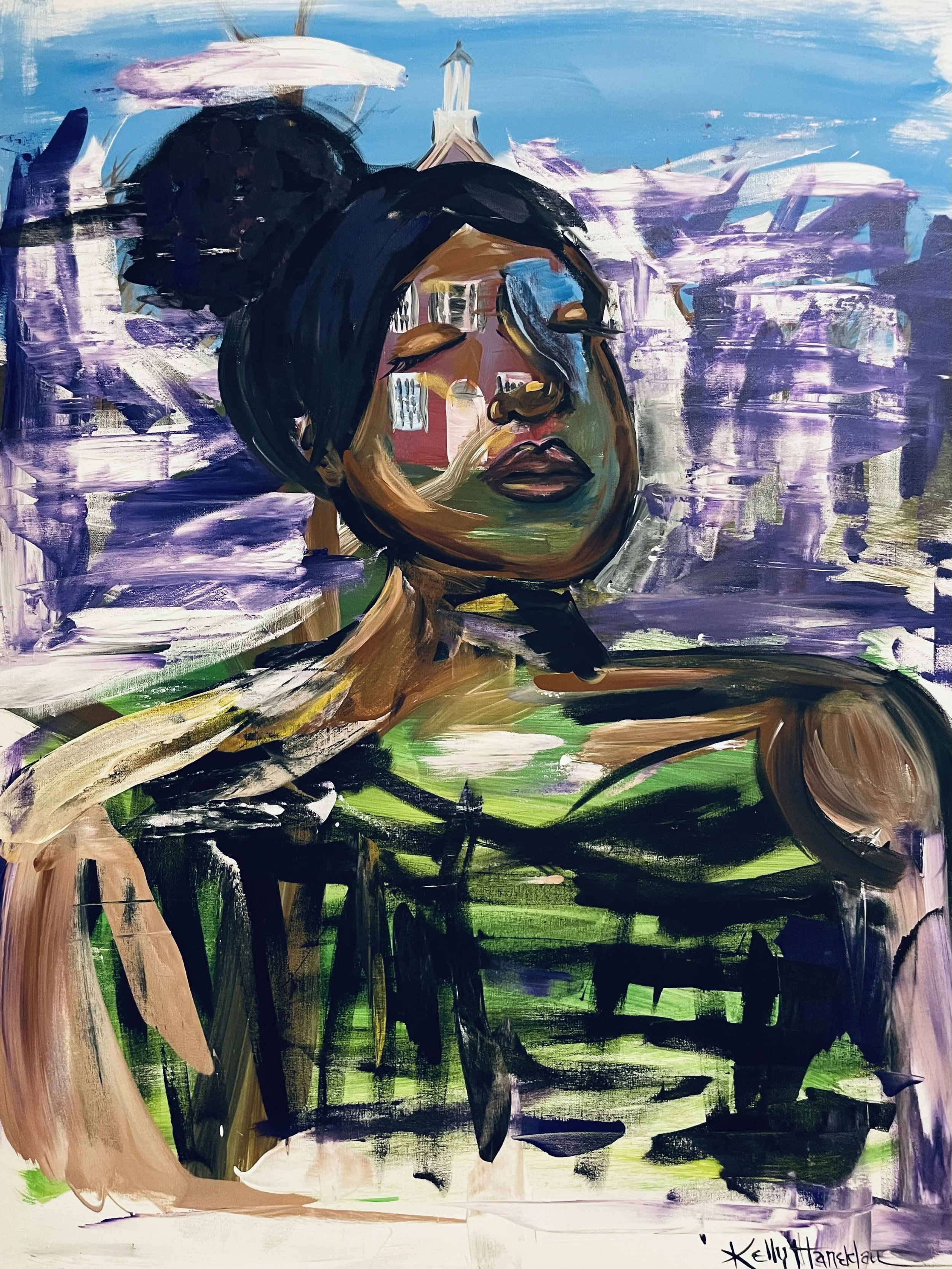
“Longing” by Kelly Haneklau
On a recent visit home to see my parents, I came across a photo of my mom, taken sometime towards the end of the 1970s. She is wearing a traditional kimono, the loose sleeves billowing down her sides and a thick obi tied around her slim waist. Her back is to the camera, but she has turned around to smile, presumably at my dad taking the picture. She is younger and skinnier than I have ever known her, her face more angular but just as warm, her light brown hair thicker, in a bob that curves towards her pale chin. The familiar look she sends to the observer changes her from a foreigner playing dress-up to someone welcomed in.
The photo immediately reminded me of another one in our family collections—of me, in elementary school, wearing a kimono of my own. It is hot pink with a white crane and lotus flower print. A blue and white ombré obi is wrapped around my tiny waist, secured into a bow at the back by my mom. My long dark hair is tied into a braid running down my back. I smile impishly at the camera, my slender hands folded in front of me, my little toes peeking out from the uncomfortable geta. I’m posing at the edge of our kitchen beneath a sepia photo of my mom’s hometown of Gorey, Ireland.
The little girl and the young woman in these photos don’t look much alike. No one has ever told me that I have my mother’s eyes or chin or nose, a marker that she created me, that I am hers. I don’t look exactly like my dad either, but we have the same slim frame, our dark eyes the same crescent moon curve, my skin tans to a similar shade of brown in the summer sun. People aren’t surprised when they learn my name, clucking with the satisfaction of clicking a puzzle piece into place. But growing up, my mom was the one I naturally gravitated towards, and I never saw myself as similar to my dad—our physical similarities and shared name always seemed like the extent of my inheritance from him.
My mom was the avid reader, the lover of classical music, the endlessly knowledgeable source of culture. I don’t know if I developed the same tastes in an attempt to be like her or if I would have always been inclined towards those interests through some kind of genetic imprinting—but they certainly came from her. She took me to libraries, plays, museums, and concerts from a young age, molding Shakespearean soliloquies, Hopper lighthouses, and Bach counterpoint into the creases of my brain as they began to take shape.
It wasn’t as effortless for my dad and I to connect in the same way, even though he was an integral part of every day of my childhood. He was the first one I saw in the morning when he made sure I was getting out of bed for school while my mom slept in, the one eating oatmeal next to me while I silently stirred Swiss Miss into a mug of hot water. He was the one to pack my lunches for school, an assemblage of American standards—apple, chips, mini Snickers—with one element slightly off, like the dreaded pepperoni-and-cheddar-cheese sandwiches that I freely criticized, innocently devoid of gratitude. He came to everything, cheering on the sidelines of soccer games and videotaping piano recitals after working a full week at his job as a pharmaceutical chemist. A form of love I can see now as an adult but that I took for granted as a child—that’s just what dads were supposed to do.
Unlike my mom, he and I didn’t share much in common. He’s a quiet man who spent most of the day working at a job I didn’t really understand, and it felt like we didn’t have anything to talk about. I can’t recall him ever asking me many questions about my day, and I volunteered little to him either.
My dad didn’t speak Japanese to my brothers and me in our earliest years because my mom wasn’t fluent, and they thought it would be strange for their kids to communicate with one parent while the other couldn’t understand. He tried to teach us some when we got a bit older, but it never took. I actively resisted, uninterested in sitting down with my dad in front of a hand-held chalkboard when I could have been off annoying my older brothers. I didn’t want his attention.
My dad is as un-melodramatic as they come, and he claims that he can’t speak Japanese any more, having lived outside his homeland for more than forty years. But I wonder now how he dealt with never speaking to his own children in the language of his childhood. I still don’t speak Japanese; I even Americanize the pronunciation of my name, a habit that took hold early, before I was even conscious of doing it. If I had learned to speak his language, would it have drawn us closer, sharing jokes, turns of phrase, stories from the past? Or would it have made no difference if we weren’t talking about the books I was reading, the movies I was watching, the classes I was taking?
I never thought about any of this at the time. As a kid, I was happy to latch onto my mom and spend less time with my dad. But now, my parents are in their seventies and eighties, and I’m past the age when my mom had her first two children. I look back on those memories and think how unfair it was that I didn’t appreciate the love my dad showed for me in the way I did with my mom. I wonder how that continues to shape my relationships with them, as I am still closer to my mom than to my dad, and I am running out of time with each of them.
* * *
My mom took the photos of me in the kimono each year during an annual World’s Fair-style cultural heritage event held by my well-meaning, not particularly diverse Connecticut elementary school. While the other kids draped themselves in Italian flags, handed out paper plates of German chocolate cake, or skewered toothpicks of Polish sausage, I trotted out in my pink kimono to hawk the gyoza we’d bought from a Korean market called Oriental Pantry a half-hour drive away.
To be honest, I liked having the most unique and interesting exhibit in a sea of predictably pasty European traditions. Contrary to the typical narrative of the child of immigrants who feels torn between their parents’ cultural values and their life as an American, it didn’t seem that hard to me as a kid—my parents’ origins seemed more like a fun fact, my go-to for inane ice-breakers, than a source of inner angst. Many of my classmates’ parents had grown up in our town of Clinton, or at the furthest, East Haven, nowhere near as far flung as Japan or Ireland. My parents had left their home countries for the greater pursuit of knowledge and adventure, and even if they had ultimately made what seemed to me the unbearably boring choice of settling down in a quiet Connecticut hamlet, at least they, and therefore I, had a good backstory.
Living in a town where almost everyone was white made me aware of how I was different on some level, but mostly, it made me not think about my identity at all. There were a couple obvious drawbacks: my immigrant household did little to familiarize me with essentials of American pop culture like Backstreet Boys lyrics or the existence of Dawson’s Creek. Classmates would downplay my good grades with the breezy put-down “because she’s Asian,” the kind of comment that few people blinked at during the ’90s and 2000s. I didn’t think much about those comments at the time either. I felt isolated more due to being a nerd than because I was biracial or had parents who came from far-away places—I didn’t even think about those as possible reasons for being singled out as different.
And even though I was different at school, home created a separate world for me that I always saw as normal. I snuggled with my mom while laughing at Fawlty Towers and watched Miyazaki movies with my brothers. Short-grain white rice scooped steaming from the rice cooker or boiled potatoes with a pat of butter and salt were our daily dinner staples, rarely served before the “civilized hour” of 8 p.m. My parents would share a kettle of boiled water every night, most of it going towards my mom’s seventh pot of tea of the day and a smaller portion reserved for my dad’s mug of green tea.
* * *
Despite our difference in appearance, it has always been clear to me that I am my mother’s daughter. She is the source of what became my lifelong obsession with the English language. In grade school, I devoured set after set of British boarding school novels that she had grown up reading—Malory Towers, The Chalet School, and Enid Blyton’s unfortunately named Naughtiest Girl series—alongside that more standard British export about the boy wizard with the funny scar. I fell in love with Mr. Darcy for the first time in sixth grade and became fluent in BBC adaptations. In high school and college, I took a more serious interest in literature, the more British, the better. I took any course with Austen or George Eliot on the syllabus, carving out a sense of intellectual refinement for myself through the books I read, like a Jamesian American heroine trying to pass for a European. My parents had worried that speaking Japanese at home would connect us to one parent and exclude the other—but by the time I graduated from college, I communicated with my mom through our shared love of Western culture, a language that my dad didn’t speak.
After graduating from college, I decided to double-down on my attachment to British literature, moving to northern California to start a PhD specializing in Victorian novels. I left the East Coast to pursue a degree that would establish my expertise and officially tie my public identity to my knowledge of the literary tradition I had grown up with. I waded deeper into the canon, studying the grotesque oddities of Dickensian London, the dry narrators and sly heroines of Trollope, the almost comically unrelenting hardships of Hardy’s countryside, trading thoughts with my mom on every visit home as she reread the classics I was diving into for the first time.
While immersing myself further into the familiar world of British lit, I was suddenly living in a foreign land to a New Englander—a place without winter, palm trees swaying against a blue sky every month of the year. The leaves didn’t change color, but the hills did, from the lush green of winter to the burnt yellow of summer. Instead of cardinals and cottontail bunnies, there were shrieking scrub jays and awkward jackrabbits. I was startled by grocery store cashiers who actually tried to make conversation while they scanned my purchases instead of politely but silently exchanging money as I was used to.
As strange as things felt, I discovered new pleasures. In place of turkey sandwiches, I could buy carnitas tacos or a spicy tuna sushi burrito all on the same block. The Bay Area was a much more diverse place than the Connecticut town where I had grown up, and it was populated with far more Asians than I had ever lived alongside before. Ramen was so ubiquitous that different restaurants specialized in distinct styles of broth, a far cry from my previous discernment between “Original” versus “Shrimp” flavors of the Sapporo Ichiban instant ramen we had stocked up on at home. There was a branch of the Asian mega-grocery store Mitsuwa as close as San Jose, a chain my family had taken annual road trips to visit in New Jersey from Connecticut, never mind the smaller local Japanese store that was a quick bike ride from my apartment.
It made me realize how little Japanese food and culture had been available to me outside my home growing up, how isolated I had been as one of the few Asian Americans in my town, and how I had barely thought about my own Japanese identity because of that. Before, my Japanese heritage had been a fun fact for others to be intrigued by. Now, it was a source of commonality with others around me.
Even when I moved to the more remote, whiter locale of Monterey for my first teaching job, I would often stop by a mom-and-pop Japanese restaurant in town for takeout after my weekly yoga class. They made simple, standard Japanese comfort food that I’d eaten at home and on trips to Japan as a kid: thick curry topped with katsu pork, chicken donburi laden with onions and egg, skewers of takoyaki drizzled with tonkatsu sauce, all accompanied by heaping mounds of sticky white rice. When I called in my orders, it was comforting to know that I could pronounce my name the Japanese way, the way my family says it, confident that there would be no stumble to comprehend what I had said or how to spell it.
One night as I picked up my order, one of the owners, a middle-aged Japanese woman, greeted and spoke to me in Japanese. I stammered an apology that I didn’t speak the language, feeling recognized and called out at the same time. She had immediately known that I was Japanese, when people typically fumbled to identify my ambiguous ethnic appearance. But did I really have anything in common with this woman if I didn’t speak her language?
“That’s okay. Neither do my kids,” she said with a friendly laugh. I smiled back, relieved that I was still welcomed in. It was reassuring to hear that I wasn’t the only one who had grown up eating this food, who looked the way I did, but couldn’t speak to my own parent in his native language. I felt seen as a Japanese American, something that had never happened to me growing up in Connecticut, to the point where I hadn’t fully seen it in myself.
* * *
Growing up, I was probably more aware than the average American kid about the Japanese side of World War II. But there were still basic facts that didn’t really hit me until I was an adult living in California, a state that had established two internment camps during the war, camps that my dad, brothers, and I would have been put into had we been living there in 1942.
I never visited Manzanar or sought out any historical sites related to Japanese Americans in California. But living in a place where Asian American culture was far more normalized than it was where I’d grown up made me think more about the Japanese side of myself. Maybe that was all it took to send me down a Wikipedia rabbit hole one evening that led me to learn more about the air raids of Japan during World War II.
As I clicked from page to page, I learned that many more cities in Japan were attacked beyond the infamous atom bombs dropped on Nagasaki and Hiroshima. The U.S. targeted Osaka, the city where my dad grew up and that I visited as a kid on family trips, from March 1945 to the last day of the war. They killed thousands. I did the math—my dad was two years old at the time.
I was shocked. I had known about the bombings of London and Dresden from high school history classes, but not this. I had known in a vague way that my dad’s childhood must have been difficult, but not that his family had lived so close to some of the most destructive effects of the war. How could I not have known this about the man who raised me? Why had no one told me? Why hadn’t I asked?
I grew up with a poster-size photo of Himeji-Jo in my bedroom, a feudal-era castle near Osaka that survived the bombings and that I toured as a bored five-year-old with my family. Thinking about that poster now, it’s hard to fathom the gap between the two-year-old Japanese boy and his terrified parents and my peaceful, comfortable childhood in Connecticut, sheltered even from the history of what had happened to my own family.
The only memory my dad refers to about that time is of his father carrying home a rationed sack of rice for their family. To this day, my dad cannot toss any leftovers, no matter how small, and eats a strange amalgam of whatever is in the fridge for lunch, often topped with mayo and a generous dose of salt. When I was younger, I would find it irritating that he would save a quarter of a bowl of salad soggy with dressing, cover it in plastic wrap, and stow it away in a dark corner of the fridge. Why couldn’t he be normal and throw out something that no one wanted to eat instead of insisting on finishing it himself?
And yet, I will eat half a banana and then save the rest for my breakfast the next morning. I eat the same meal for days on end and judge those who don’t eat leftovers as spoiled. My freezer has vegetal debris from the previous summer’s produce, just in case I might make stock out of it one day. When taking out a load of recycling one day, I realized that I had been using the same Trader Joe’s paper bag to haul empty bottles for six years. I had no idea why I did this—except why would you throw out a perfectly good paper bag?
Even though I thought I had little in common with my dad, he had imprinted on me just like my mom had. I’ve never lived under the conditions of scarcity that my dad experienced after the war, largely thanks to his commitment to his career, to supporting his family, to his careful planning and financial responsibility. But he did pass on his impulse to hold onto things, born out of his own upbringing in post-war Japan. What I had seen as an annoying eccentricity turned out to be a link between us, between myself and his experiences in another place and time.
* * *
“This brings me back,” my dad says. My parents, brother, and I are out to dinner for my brother’s birthday at a Japanese izakaya restaurant in Cambridge, digging into plates of takoyaki, saba, agedashi tofu, and shishito peppers. I moved back to New England several years ago, making it easier to see my parents more frequently than just Christmas and summer vacation.
“You know the novel Pachinko?” he asks me. To my surprise, my dad has taken up reading as a new hobby in retirement, making his way through anything from ancient Greek literature to the latest bestseller. I nod. “You know the bar where the main character works in Japan? This is the kind of food they’d serve at a place like that.”
The conversation moves onto tennis (another shared obsession of me and my mom) and my brother’s work. I notice that my dad falls quiet, his usual mode at family gatherings. He’s hard of hearing and not as chatty as my mom or me, so it’s easy for him to fall into the background of a conversation.
“What are you reading these days?” I ask him. My dad now loves to tell me about the latest book he’s picked up, asking me if I’ve read it too and what I think. I try to make sure to ask him whenever I see him, reaching out in a way that I never did as a child. It’s a small step towards loving him the way he has always loved me, to returning to him what I feel I owe him.
I’ve known for a long time, from when I first started making choices about what I wanted my life to be, what my mom gave to me: literature, culture, a model and companion to guide me through what I prize most in the world. It took leaving home and experiencing a new life far away for me to see what my dad had given me. Recognizing the Japanese part of my identity drew me closer to understanding him, made me appreciate how he had protected me from the hardship that had been inflicted on his family when he was a child, helped me to see the side of myself that came from him. A hot pink kimono, a six-year-old paper bag, a lingering feeling of being seen by a stranger with the same heritage—these are all tethers to my dad, to a two-year-old boy sheltering from a war, to the man who got me ready for school every morning, to the language that we share.
About the Author
Akemi Ueda is a writer and high school English teacher living in the Boston area. Her work has been published in Mochi Magazine and Open Secrets and is forthcoming in WBUR's Cognoscenti.
about the artist
Kelly Haneklau is a free-lance multidisciplinary artist who works primarily in oil and acrylic. Her style ranges from abstract to realism and her current subject matter is centered around bringing a voice to disadvantaged people. Curious by nature, she does not conform to any one art methodology and is diverse in many styles and techniques. Passionate about public art, she also works as a muralist and a speed-painter with K[squared]² performance group. She is an internationally published artist, children’s book illustrator and art instructor. Kelly has received multiple awards for her artwork and community volunteerism. These two passions culminated in her founding the nonprofit, Art of Life Charities – whose mission is to employ the arts to support communities in need. She accepts commissions and her work can be found hanging in galleries, on sides of buildings, in books/publications and private collections around the United States. Find out more about Kelly at: www.kellyhaneklau.com, FB/LinkedIN: Art by Kelly Haneklau, or IG: @kellyhaneklau