
Made Low
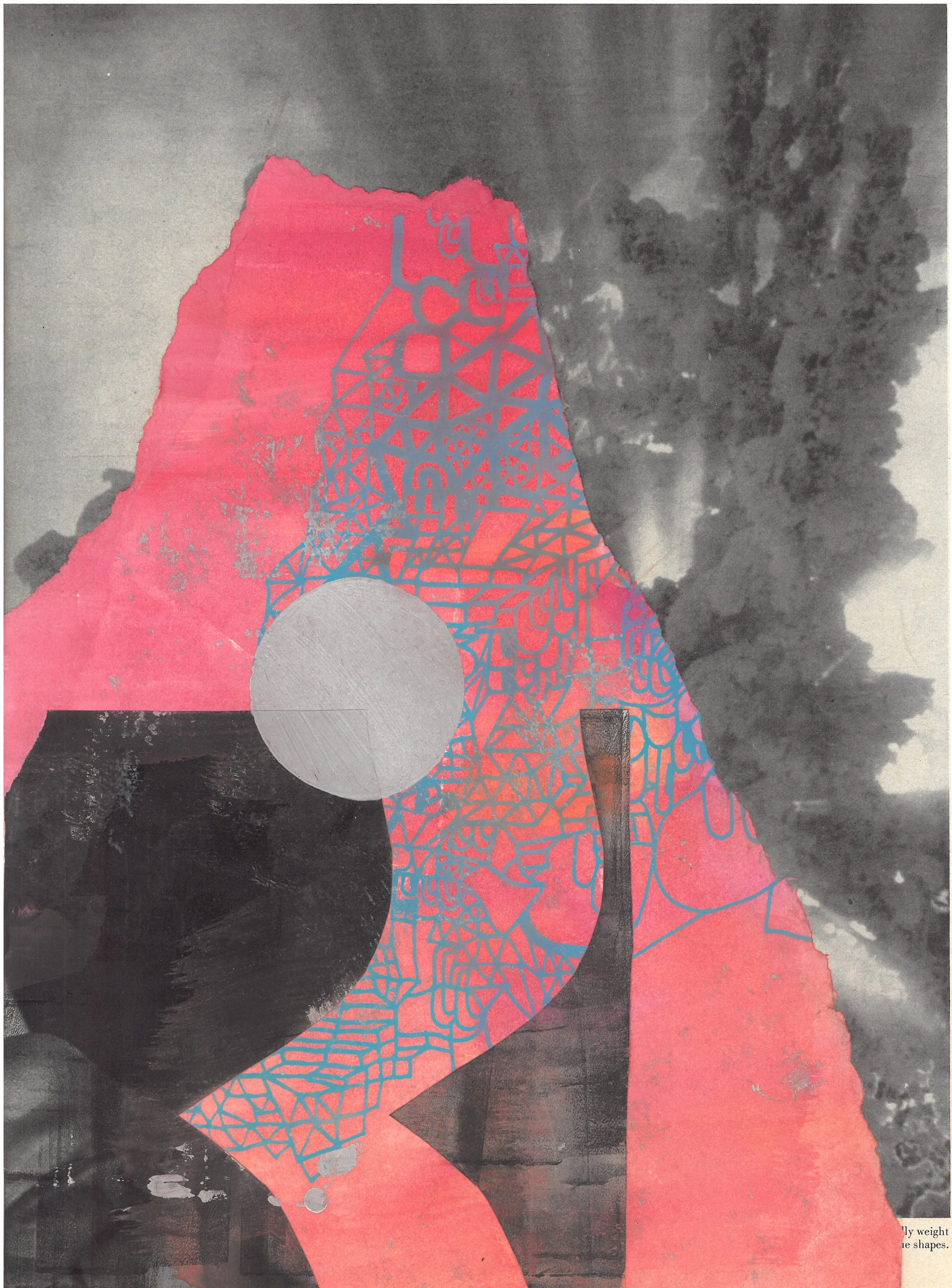
“Watercolor Mountain Collage” - Ann Petroliunas
Talk of Mount St. Helens surrounded us during the spring of 1980, a few months after I turned six. Everyone learned from the TV news and the newspaper about the steam vents and the earthquake activity under its surface, and people in Ellensburg would refer to the mountain with wary affection, trying out their knowledge of the mountain’s original names—newly acquired, for most of them. Loowit. Si Yett. Louwala-Clough, smoking mountain. The adults spoke with hushed reverence about those who planned to stay put for the imminent blast—the lodge caretaker at Spirit Lake, various stubborn codgers and volcanologists—and at kindergarten the teacher had us make paper mâché volcanoes and add baking soda and vinegar and sing our own classroom version of “On Top of Old Smokey,” with bespoke lyrics for our neighborhood steamer, which we knew would make history sometime soon.
Mr. Fischer from down the block came to our door one April evening, wearing his usual cabbie hat and thick framed glasses. I hid behind an armchair and listened to him address my father at the threshold. My dad was drunk and pretending not to be, whereas Mr. Fischer was proper and upright, a retired soil scientist from the local university, a tidy gardener and compulsive lawn edger. He advised my father to fill our bathtub with drinking water. “It could happen summer, or sooner,” said Mr. Fischer. “We just don’t know.” My father did fill the tub that night, but then he took a long bath and made a ruckus late when my mother fished him out, pruned and surly, belting out parts of a song off key. From my room I heard him growl at her as the tub drained.
My mother used to talk a lot in those days about the wind. There were the St. Helens conversations at the grocery store or school drop-off, where adults would speculate about how volcanic ash might loft up and spread in the atmosphere, and she’d talk about the wind on the phone with Per. Per was her handsome sculptor friend, a visiting lecturer from Sweden. I’d hear her tell him they would “have to see which way the wind blows,” and I couldn’t tell if they were talking about Mt. St. Helens or something else in the future, some other uncertainty, that made her blush and laugh softly and spend just a few minutes longer on the phone. I had met him once or twice in our kitchen, sock-footed and grinning, a bit sweaty, just about to be going, he told me in his lilting English. He was at our house to visit my mother and talk about art, which she said she missed since we had moved from the city to the cow town for my dad’s university job. I didn’t understand why she called it a cow town, as there were no cows to be found in front of the red brick campus buildings or on Main Street or in the alley behind Franzini’s Pizza and Shapiro’s dance shop, although I looked for them everywhere we went.
It was around this time my mother decided to transcribe by hand a section of Handel’s Messiah for Per. His father, whom he had recently lost to cancer, was a Lutheran minister and a timpanist in a community orchestra outside of Stockholm. Per missed him terribly, she told me, especially during this time when he was living thousands of miles away from home, and so she wanted to create this sentimental gift for him. I could see it brought her joy.
Our days together were intimate and imaginative, spent playing pioneers with her and my toddler sister in the park, making up stories when we drove to Yakima to visit my grandparents, but she must have found them to be routine-bound and isolating. There wasn’t a lot of money as my dad started anew as an adjunct. She spent her days looking after us, our pets, and a few scraggly orchids that she named and labored to keep alive, whispering jokes and encouragement to them in the kitchen. Then she started inking the score. Years later, she told me that she had learned music calligraphy as a conservatory student in New York as a way to manage her performance jitters. A scholarship pianist, she had left behind the orchards and fruit warehouses of her Central Washington hometown and cultivated a creative life for herself. She met my dad in Manhattan—he was finishing up his PhD in anthropology at NYU—and they had me, then my sister. After a few years they came west to Washington State for proximity to my mother’s parents and a job they hoped my father could hold down after getting fired from his previous teaching position for injuring a fellow faculty member in a drunken party stunt duel. He’d been a fencer in college. Not a very good one, according to my mother.
“That was a long time ago,” she said about her days in New York.
It was painstaking work she took on that spring of 1980, drawing the staff and accidentals, furious clusters of notes, page after page. “For Per,” she told me, more than once, and I could see the devotion shining in her eyes. Not devotion to God, as my mother was practically hostile to religious expression, but the Messiah was clearly her love letter to Per, and to artmaking, and to some essential part of herself that she refused to let fade away.
She wouldn’t let me touch the pages, even after the ink had dried, but she welcomed my curiosity. One afternoon after I was home from kindergarten, she called me to her side to examine a page she had just completed. She told me to read the words out loud, helping me sound out the ones I didn’t know. She moved her index finger in the air above the score, following my words and then she sang the verse—from the Book of Isaiah—to me in a clear, precise vibrato.
Every valley shall be exalted, and every mountain and hill made low, the crooked straight, and the rough places plain.
***
“How much lava is inside Mount St. Helens, Mama?”
I asked her this question at bedtime one night in May as the scent of rhododendrons drifted in through the bedroom window. She had tucked me in and was lingering, which I loved. My sister was fast asleep and our father wasn’t home. It was a Friday, and he was out with colleagues and students. My mother read me one story and then let me read another to her. She let me ask her questions about her days as a conservatory student in Manhattan and about Handel’s Messiah; she had finished the score for Per and was waiting for the perfect moment to present it to him. I thought about asking her if she and Per had ever hugged—thought about his big smile and blond curls—but stopped myself, blushing in the dark. After a few minutes she lay down alongside me, her soft back to me. I slid my fingers under her sweater and started scratching along the ridge of her shoulder blade.
“It is full of lava, but the scientists don’t think it will come out,” she said. “I don’t think she wants to do that, make all that fire. Connecticut.”
I was learning the map of the states and back-scratching was our way for me to practice.
“I don’t know that one, Mama.” I mostly knew western states. All the really large ones.
“Connecticut is the right bra strap state.”
“Okay.” I moved my fingers and scratched there. “Who is ‘she’? Mount St. Helens?”
“Mount St. Helens’ real name is Loowit. A long time ago she was an old woman and then she… Dang it, I can’t remember how the story goes, honey. It’s a good one, too… Shoot.”
“But I want to hear it! My turn for scratch.”
We both turned over and she started scratching my back.
“Washington,” I said, wriggling with delight. “Tell me about the volcano woman.” I heard her sigh, thinking.
“Loowit was lonely. She lived out in the boonies and her days were long and dull. The Great Spirit noticed that she was sad. He told her she could live forever, and this made her even more sad, but then he gave her another gift, which was to make her young and beautiful.”
“Florida.” Her fingers scratched eastward, crossing my spine. “What happened next?”
“Two young men fell in love with her. She couldn’t choose between them and they fought over her and caused all kinds of trouble. Fires and destruction. Finally the Great Spirit had it and turned them all into mountains. My turn.” We flipped onto our other sides and I scratched in a circle, awaiting instructions.
“Is the Great Spirit God, Mama? Is God angry again and that’s why the mountain is going to explode?”
“Oh no, it’s folklore, sweetie, from the native people who lived here before the pioneers came. And I’m probably getting the story all wrong anyhow. It was in Sunday’s paper... I think we still have it.” She yawned. I thought for a minute then scratched her shoulder in her favorite place. “New York,” she murmured, sounding sleepy. I was still full of questions, and I wanted her to stay with me. I did my best gentle scratching and she started singing, quiet and sad.
Start spreading the news
I'm leaving today
I want to be a part of it
New York, New York
I came into the kitchen very early the next morning and found her sitting in the dark, sipping coffee in her Batik print robe with the cat on her lap. Somehow I knew my father hadn’t come home. This didn’t surprise me, so I didn’t ask. I poured myself a bowl of cereal and switched on the blare of Saturday morning cartoons in the living room. After a few minutes she called to me from the doorway, resting the phone receiver against her collarbone.
“We’re driving to Grandma’s. Go pack a few things. I’ll help your sister.”
I hesitated, listening to her end of her phone conversation with her mother. She said she didn’t think it was going to happen, today or anytime soon. Yes, increased seismic activity had been reported in the past week, but the skies were sunny and calm. She wanted to leave now.
My little sister and I carried our tiny floral suitcases to the orange Vanagon while our mother poured two bowls of dry food for the cat and packed up our beagle, a bag of dog food, her address book, and a bag of pears. I ran my fingertips along the grain of the corduroy van bench, relishing its straight lines while I listened to her arrange things in the cargo area behind me. I tried to remember how the Messiah went, but I couldn’t. I wanted to go back to that quiet warm moment after kindergarten, alone with my mom and her ink and sheet music. I thought I might ask her to sing it for me as she had done that day.
Just one more thing. We waited in silence until she emerged bearing her prize orchid, its pot set on a dinner plate she held between her hands, as if she were about to serve it. The sky was gray, more putrid than rain laden, heavy like the bread starter we had created then neglected in our fridge. Mom got into the driver’s seat, set the plant on the floor, and applied her lipstick in the rearview mirror as she always did before backing out.
The engine sounds lulled us, and soon my sister and the beagle and I were all asleep. I awakened after some time to the acrid tang of dust burning off the heater. The engine idled, and I saw that our mother had pulled off on the shoulder of a desolate stretch of highway. We were atop Manastash Ridge, the dusty plateau above the agricultural Kittitas Valley, where we lived. I looked over at my sister, still asleep and sucking her thumb, and at my mother, standing a few feet away from the van. A sagebrush, blown loose and needy, crowded her ankles. My mother’s hand shielded her eyes and she appeared to salute the morning. I watched her scan the horizon and the movement of the monstrous plume, rising from the southwest and reaching toward the sun.
I watched her for a few long minutes until a state trooper pulled up behind us, bright lights dancing across our van’s cloth ceiling in a pattern. My sister woke up and grabbed my hand. What’s happening, where’s mama? We watched through the windshield as the trooper and our mother argued outside. He pointed back the way we came, back down the hill toward our cow town, finger jabbing at the air. He tugged on the brim of his hat, gestured toward the mountain on the horizon and shook his head. At last, she climbed into the driver’s seat and told us we’d be turning around and following the trooper back to our house. They were about to close the road ahead of us. The volcano had blown, but it was far away, she told us. We still had time. My sister started wailing and our beagle joined in. My mother eased out onto the highway and made a sweeping U-turn, following the patrol car. I knew we had stopped near the Army training facility, so familiar to me from the drive to grandma’s house, and I looked for the camouflaged vehicles we always saw parked in the sagebrush. Either we were too far away or I couldn’t see them, perhaps the light was dimming already. I couldn’t see the trucks and tanks, though I half expected them to come to life and crawl across the high desert like creatures, joining our slow parade.
My mother didn’t speak for most of the drive back down the hill to town. She gripped the steering wheel, her mouth a grim line, and my sister pressed her hands to her eyes, asking me if it was time for bed. I didn’t answer, and before long, incredibly, she slept as a darkness that resembled evening rolled in. By the time we descended into the Kittitas Valley and entered town, ash had begun to fall like snow, but slower, floating in the air before reaching the ground. A thin gray layer coated the trooper’s bumper and taillights. He drove slower and slower, hazard lights flashing, and my mother did the same. As we turned onto our street, we passed a garbage truck parked to block off a major road, flares set around it. An emergency siren ricocheted off the hulking shapes of unlit campus buildings. It was as dark as night by the time we got to our house, even though it was only noon. All the lights were on inside and we could see our father pacing in the living room. As we pulled into the driveway, my sister started fussing. Our mother told us to stay in the car while she talked to our father and the trooper, who was waiting by the driver’s side door with a Maglite and a notepad, a handkerchief covering his mouth and nose. When she opened her door to get out he rushed over to tell her she couldn’t leave us in the car. Unknown poison gases and god knows what we were breathing, more by the minute. We all needed to get inside immediately—he needed to go—and she’d be hearing from the Sheriff about her recklessness. She told him that he should back off, that she didn’t know today was the day it was going to happen. After all these years, I still don’t know if she meant the volcano deciding to erupt or her deciding to leave my father. He loomed on the other side of the picture window, apoplectic, like a bee trapped in a jar.
When we came through the door he crouched down and hugged me, and while he didn’t smell like booze, he hadn’t shaved in a couple of days and his cheek scraped mine. He pulled my sister into our huddle and told us we didn’t know how long the power would stay on, or the water. We needed to go wait in our room while he and our mother listened to the emergency radio and figured out what they needed to do to keep us safe. This surprised me—him suddenly around and taking charge felt so unnatural—but everything that day felt unnatural and alarming. I nodded and led my sister upstairs to our room. She climbed into bed and started sucking her thumb. I stood on my bed, where I had a view of the street below. The trooper had left, and I saw Mr. Fischer walk by swinging a lantern, wearing a gas mask and snowshoes. Up and down the block he walked, looking for stragglers, I suppose, caught out in the ash storm. Wanting to be useful. He’d gone home by the time Per pulled up in his little VW Karmann Ghia.
I watched as Per cut a path through the fresh ashfall on our front lawn, wearing a bright orange rain slicker with a hood pulled up over his head. I could hardly make out his golden mustache—his head was bowed as he walked with purpose toward our front door. I ran to my closed bedroom door and put my ear against it. I heard my father, downstairs, curse at my mother and throw the front door open. I opened my bedroom door, told my sister to stay, and crawled out to my listening spot near the top of the stairs.
“Why don’t you come in on this lovely Sunday morning,” my father sneered. “Come sit down and we’ll talk this through like adults. Like you civilized, neutral Scandinavians. We’ll all take a sauna afterwards and make pancakes naked.”
“You didn’t even come home last night,” my mother said to him.
“You take me for a goddamn fool then decide to take my children into a blast zone without a word to me.”
“What do you expect, Don? You expect me to raise the girls and make your dinner while you run around doing whatever the hell you want! You take me for granted and I’m sick of it. And no one knew when the eruption would happen. Don’t try to pin that on me.”
“Cowards!”
The boom of his voice jolted me. I scooted up one stair and tucked my knees back in.
“We can talk about it all now,” she said. I could tell she was furious, her plan foiled.
“You feckless lying bitch. Putting our children in danger for your runaway fantasy.”
“Don’t talk to her that way,” said Per, finally speaking up. “You want to have a problem? Have a problem with me.” His voice sounded tinny and tough in a put-on way, like he was reciting a line of dialogue from a TV drama. It didn’t work. My father, five inches taller than him, hairy and enormous as a bear, had had enough.
“Do I want to have a problem?”
I heard them grunt and struggle as they crashed around the room, my mother shrieking at them to stop. The dog started barking when they knocked the stereo speaker over.
“Don’t do this!” she shouted at my father. “You can’t change my mind! I’m not letting you ruin my life anymore!” I heard him hiss something sinister to Per.
I heard my sister whimpering, so I went back into our room, climbed onto her bed and stroked her hair. It seemed like things had quieted down but then they roared back up again. I heard a heavy thud and the sound of something large and solid cracking downstairs. I tried to figure out which objects had broken—a straight-backed chair or the big painting that hung in our living room, the one my parents told me they bought in Peekskill when they got married. I heard Per spit and curse in what must have been Swedish. I ran back to the stairs where I could see.
Per reclined on the floor, like a guest at a picnic, except his nose and jaw were bloodied. He wiped the back of his hand across his mouth and spit out a tooth and a string of bloody saliva. My father hulked over him, brandishing a poker from our unused fireplace set. My mother cowered a few feet away, between my father and the front door. Her shaking hands covered her eyes and her mouth was silently pleading. My dad flung the poker across the room and kicked Per in the ribs. At this, Per swung himself off the ground with momentum. He shoved my father hard with both hands, sending him backward into a rickety bookshelf. My mother uncovered her face and intervened, steadying my father and putting her body between him and Per. She grabbed my father’s shirt.
She said, “This stops now. Or at the very least, take it outside.”
“Into the poison air you took my children out into? To leave me for this sponge mop?”
The men ignored her and found their way back to one another, closer to me now. I froze and watched my father grab a fistful of Per’s hair and yank him into a headlock. My father glared at my mother and spat out his words while Per struggled. Head strained in an awkward angle under my father’s grip, Per spotted me and stopped moving. The moment expanded between us as I searched his bulging eyes for answers. No one knew I was there except for him. I didn’t know him—not really—but despite his precarious position he looked at me with sorrow and regret. His strained gasps slowed as he held my gaze, trembling. My mother saw me next.
“Go back to your room!” At the sound of my mother’s voice, my father released his hold on Per and started towards me, fists balled. I wanted to run, but I knew I couldn’t leave her.
And then I turned and ran. Back to my room, to the window. I wished that my sister and I could climb out and run to a neighbor’s house, or to my private perch on the birch tree in our front yard, but the window was a foreboding black rectangle. When I pressed my face to it and looked skyward, I saw the outline of the sun—a pale halo. I had no concept of an eclipse. The streetlights had switched on, obedient to this false night, and illuminated birds flew into the front yard from every direction, shrieking and crowding each other on tree branches as soft clumps of ash floated past them.
Soon there were new sounds outside—men’s voices and radio static. A flashlight beam bounced. The doorbell rang, twice, three times fast accompanied by banging on the door, which my mother opened. It was Sheriff’s deputies, dispatched to collect a statement from her for the reckless endangerment of her children. I listened from the stairs as she explained her situation to them, thinking on her feet, making it sound as though her mother needed her help and that is why she had gathered us and fled. They let her off the hook after hearing my father’s side of the story, all bluster and outrage. In the end the deputies handcuffed him and Per and led them to separate cruisers. I watched them stagger through ankle-deep gray drifts in our yard.
After the police had pulled away from the curb, their lights disappearing into the darkness, I grabbed my sister by the hand and walked downstairs. The living room was quiet and our mother was there on her hands and knees amid the overturned furniture and books and smashed paintings and glassware, weeping. She must have known we were there, but she didn’t look up at us. I hadn’t noticed it before—Handel’s Messiah—torn to bits and scattered across the living room floor.
She occasionally inked something beautiful in the decades that followed: my wedding invitations, a lovely note to my daughter upon her high school graduation, but my mother never played nor transcribed music again. Nor did she see Per, as far as I know, or speak of him. My father’s health took a turn for the worse before too long, his liver giving out, and she cared for him.
Some aperture of possibility must have closed for her after that day of the eruption, and the hard flatness of obligation displaced whatever glimpses of beauty she had dared to imagine for herself. Even when talk of Mount St. Helens no longer surrounded us, for years I noticed the layer of ashfall that had settled along the edges of the highway, until the soil eventually absorbed it.
About the author
Jennifer Krasner is a fiction writer and editor living in Spokane, Washington and a graduate of the MFA program at Eastern Washington University.
About the Artist
Ann Petroliunas is a 2022 MFA recipient in creative writing from Portland State University. She is a high school educator, writer, and collage artist. Born and raised in Chicago, she now resides in Oregon and often gets confused about which one is home. Ocean waves, glue-sticks, and avocados are a few of her favorite things. Her writing has previously been published in The Rumpus, Heavy Feather Review, and Unchaste Anthology: V3 and her artwork in Liminal Spaces.