
Central Time
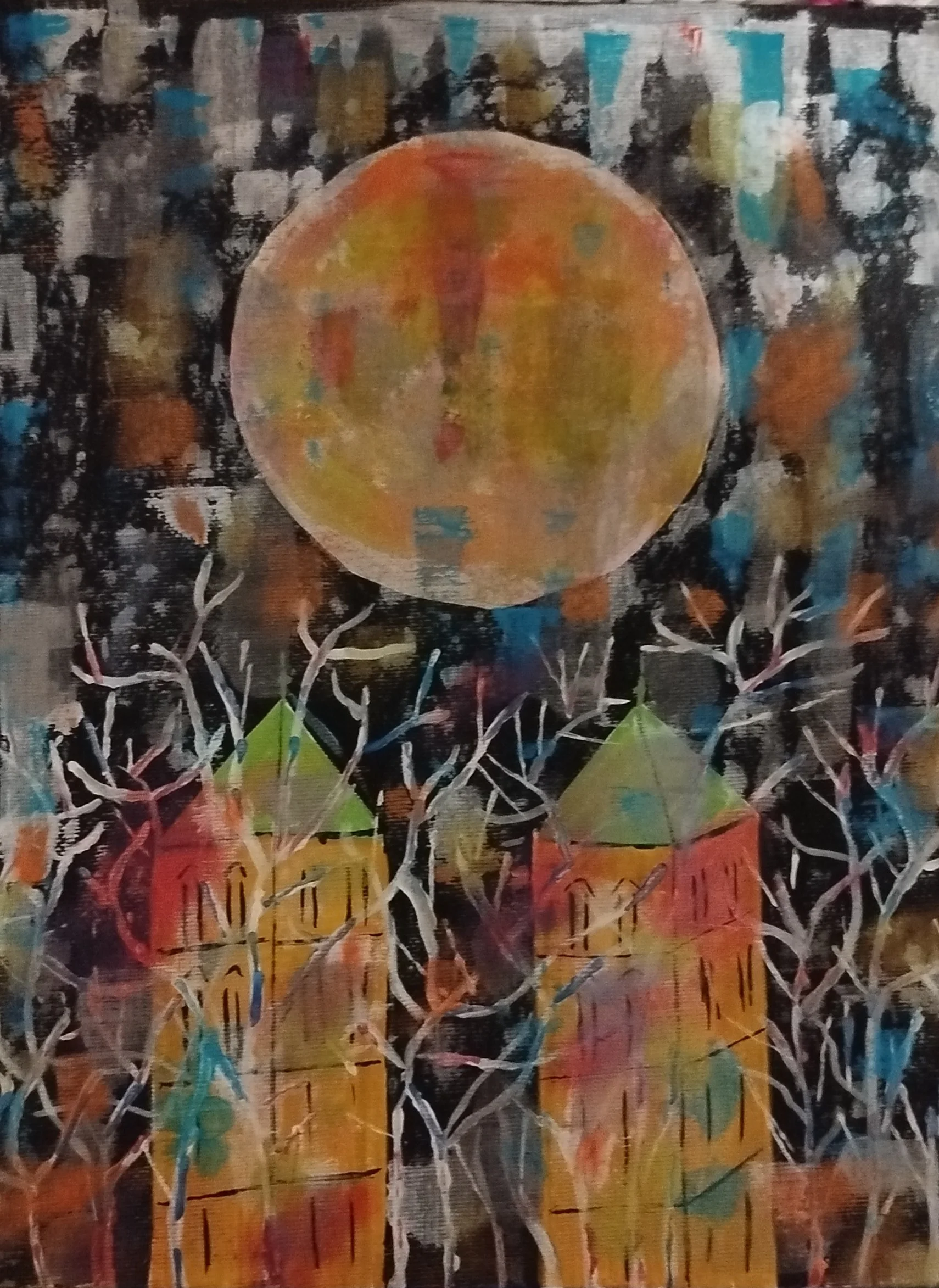
“Full Moon Over the Dom” by Nuala McEvoy
The letter arrived on a Wednesday. I carried it inside in the rain. The letters “H” and “b” bore splashes like tearstains, though they were only water, from today’s sky, a sky that hadn’t existed when this envelope was sealed.
The postmark said March 2005. Twenty years ago. Shy a month. The address was my college apartment, the one on Maple Street with the broken buzzer and the landlord who never fixed anything. Four forwarding stickers formed a staggered trail across state lines—Ohio to Massachusetts to Oregon to here, Louisiana, where I’d been for six years and thought I’d finally stopped moving.
A yellow sticker at the bottom, printed in apologetic sans serif: Delayed in processing. We regret any inconvenience.
Delayed. Inconvenience. Strange words, both, in this situation. Precision of words should be de rigueur with the post—one of the few things we are meant to rely on.
I set it on the kitchen table, still wet. The return address was Helen Beckett, my mother’s best friend, the woman who taught me to braid hair and make pie crust with cold dusty hands. Auntie Helen, though we shared no blood. She’d died in 2019. Stroke. I hadn’t made it back in time for the funeral.
The handwriting was hers—the careful loops, the slightly crowded spacing of someone who grew up when paper and ink cost something. The envelope was thin. One page, maybe two. Not a long letter. Helen hadn’t been much of a writer—and never verbose. She wrote the occasional thank-you note in three sentences and birthday cards in two. Whatever this said, it said it efficiently.
I made coffee. I didn’t open the letter.
I thought about March 2005. I would have been twenty-two, finishing my senior year, applying to graduate programs I wouldn’t get into, dating someone I never really got into either. March 2005 was before my mother’s diagnosis. Before Helen started calling me every Sunday to tell me how the treatment was going because my mother wouldn’t. Before the hospice, the will, the year I spent cleaning out a house full of objects no one wanted. Accidentally throwing out the few things they did. One person’s oversight always opens the door to grievance—in these matters, anyway.
Helen had written this letter in the Before.
I could imagine why she’d written. My mother and I had been fighting that spring—something about my refusal to come home for Easter, or my decision to move West, or the general fact of my wanting a life that didn’t—couldn’t—orbit hers. We fought often then. Helen mediated. Helen always mediated. She would’ve written to say: Be patient with her. She loves you. She doesn’t know how to say it.
Or maybe the letter said something else entirely. Maybe it was about Helen’s own life—her divorce, which had just finalized that year, or her daughter’s wedding, which I’d skipped. Maybe it wasn’t about my mother at all.
I opened my laptop. I had work. A legal filing due by end of day. I typed three sentences and deleted two. Paused to check to see whether the gate lowered in Eastern time or Central.
The letter sat there, a small monument to sleet and the gloom of night.
Here’s what I knew: if I opened it, I would learn what Helen had wanted to tell me in March 2005. If I didn’t open it, I would never know. Both of these facts were equally true and equally useless. Although both truth and utility change over time. In both directions.
My mother had been dead for fifteen years. Helen for six. Whatever advice this letter contained—about patience, about love, about coming home—it was obsolete. I had been patient. I had come home. I had sat beside my mother’s bed and held her hand while she died, and she had looked at me with eyes that no longer fully recognized who I was, and I had forgiven her for that, or at least I had stopped expecting recognition.
Although forgiveness, my expectation for that survived her.
I had done all the things I suspect Helen’s letter told me to do. Except that last one, maybe.
But what if it didn’t? What if Helen had written to say: You’re right. Your mother is impossible. Leave. Build your own life. Don’t come back.
Or not consolation at all, but injury: I’ll never forgive the years your selfishness stole from her—from all of us.
Or opportunity: Please, the experimental treatment could save her. Don’t we all want that. I’ll help with the cost.
What if the letter I never received would have changed everything?
I picked up the envelope. Turned it over. The flap was still sealed, the glue intact despite two decades of transit. I could tear it open with my thumb, or carefully with the kitchen knife sitting six inches to my left. It would take less than a second, either way.
Outside, the rain picked up. The gutters sang their tuneless song. Pretty all the same. The house—my house, the one I’d bought three years ago, the one with the garden and the mortgage and the permanence I’d built after so much moving—creaked in its familiar places. Accused in none.
I put the envelope in the kitchen table drawer. Not thrown away. Not opened. Just there, with the takeout menus and spare batteries and twisty ties and the little brass key that doesn’t open anything anymore, but still gives a lovely patina.
Helen had written it. The postal service had lost it. I had received it twenty years too late, or perhaps exactly on time for a version of me who no longer needed to know what it said.
The filing was still due at 17h00. Central. Here. Where the rain was still falling.
About the Author
J.M.C. Kane is a writer from England, though now claimed by New Orleans (U.S., not France) who has spent most of his adult life trying to fit long stories into short boxes. He has worked as a paperboy, a contracting executive, and an amateur cataloguer of human regret—none of which he was formally trained for. He was formally trained as a lawyer, but he is, frankly, a better cataloguer. His fiction has appeared in journals that appreciate compression—and his willingness to obey word counts.
about the artist
Nuala McEvoy started writing and taught herself to paint approximately five years ago, at the age of fifty. Since then, her writing has since been published in several literary magazines and she has read her poems on podcasts. Nuala paints daily using acrylics on canvas. She started submitting her artwork for publication a year ago, and since then over 100 of her paintings have been accepted for publication in over fifty literary magazines and reviews. Her art has been accepted as cover art for several of these reviews, most recently for Cutbank Magazine 103. She has had two exhibitions in Münster, Germany and currently holds an exhibition of 45 pieces in Cavendish Venues, 44 Hallam Street, London. This year her art has received four nominations for Best of the Net 2026. Find her at nualamcevoy | Instagram | Linktree.