
Boys Like Buckshot
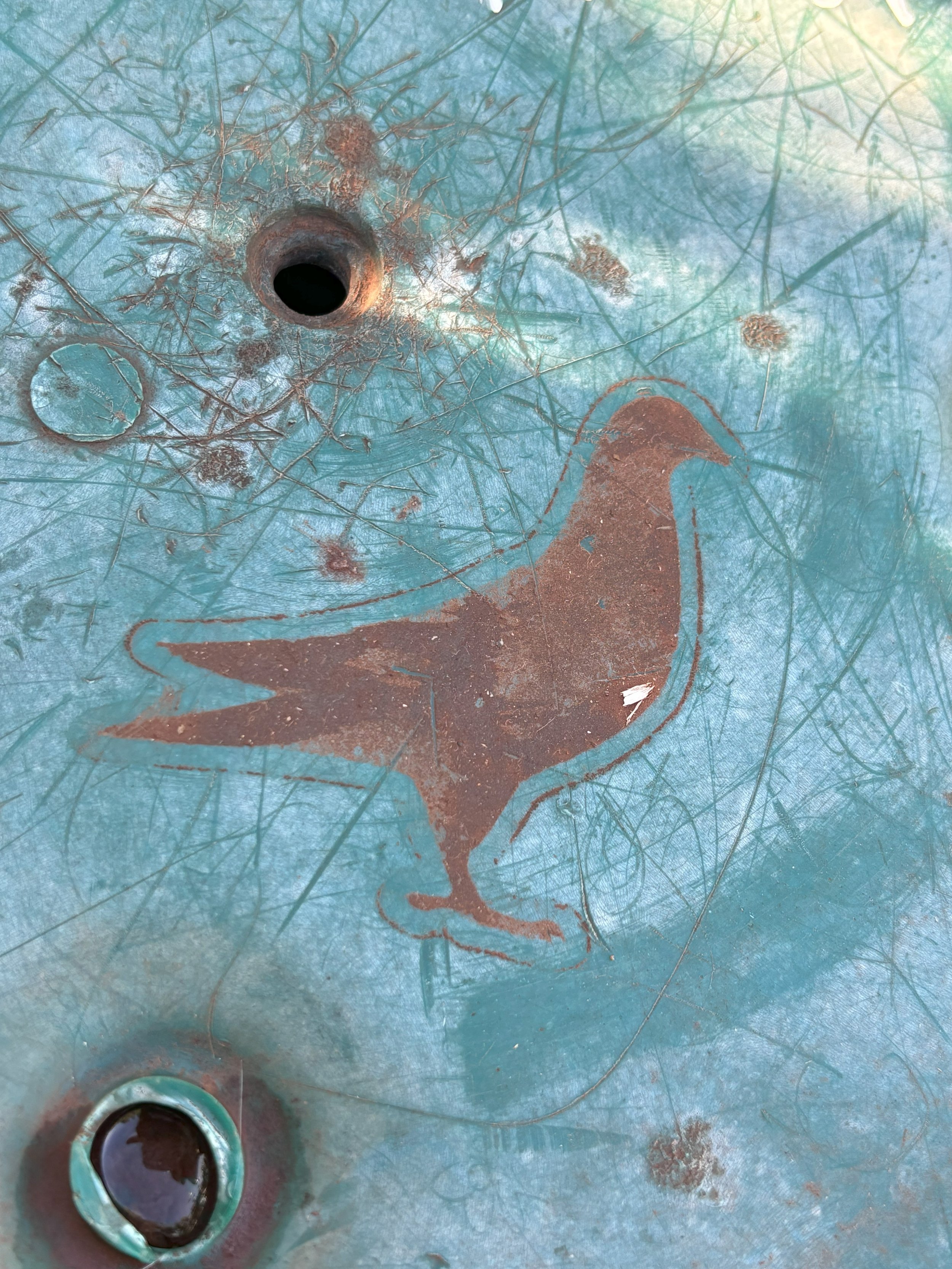
“(t)rust” by Abbie Doll
At the bonfire, Johnny’s best friends burned his family photos. He just watched, a whiskey smile cross-stitched into his stupid mouth. Above us, the moon waned like wet lips, and I wanted to kiss Johnny until neither of us could breathe. Reenact that first night, autumn of junior year, dead leaves curling in the air. Friends of friends, Crown Royal and cider in the truckbed. Everything emanated outward from him, the booze and the communal cigarettes, the stories of driving his dad back from the VFW at 13, the metronome measure for when we should all laugh and for how long. He said if we needed anything, a ride home or a kidney, he got us. I pinned him against an oak tree when we went off to piss. Caring about others was how he cared for himself, he’d tell me later. But now he just watched. Now he didn’t care at all.
I could touch the flames with my tongue, if I wanted to, taste the ash his polaroids wilted into. Instead, I just spun in the grass, stars haloing over my head, knocking over bottles and camping chairs.
***
Ma always said you can’t trust boys like that. Look at where it ended her up. Smoking at the trailer’s linoleum table. With me. Night shifts at the Clorox factory. She had dreams once. And then there was me. Poof. No more dreams. Just cartons of Pall Malls, sour boxed wine, satellite TV, chemical burns that don’t eat deep enough for workers comp.
And me.
***
Some nights, we’d pile into the bed of Johnny’s pickup and cut through county roads with the headlights off. From the driver's side window, he tossed beer bottles that spun in air forever, never hitting the ground. Johnny’s dad killed himself in his bed and pretty soon after the power company cut off the electricity. He did some landscaping. He had enough cash for beer and gasoline. And bullets. Plenty of bullets.
***
Firelight shadows snarled like the teeth of rabid animals against the sagging shell of his Dad’s house on the hill. The boys compared hunting rifles, their mouths wet, their hands bloodied in callouses.
***
Ma always said there’s no point in trying to pick ‘em right because they’ll just decide to swing on you with their left. Men, she said, proud in their infinite misery. That their idea of intimacy is a knuckle ballad sung in a broken key and a brief sweat-scarred bisection of your body from its soul.
***
Someone carried kayaks down from the house. Robust two seaters you could hitch to the lake, spend a day taking pictures of different fish, get a sunburn, enjoy life in its quiet moments. They tossed the kayaks into the trashfire. Johnny shotgunned a Bud Light, his chore coat covered in a damp rorschach. “Fuck yeah,” he kept saying. “Fuck yes. Burn it.” Burn it, burn it, burn it all. He teetered against the camp chair beside me, his afternoon shadow roadrashed in acne.
“You’re the most beautiful creature I’ve seen,” he said. “Pretty as a clay pigeon spinning up there in the sky forever and ever and ever. Never come down. Never let them hit you.”
***
Ma said it’s their friends you’ve gotta watch out for. Her smoking hand stayed perfectly still, her cigarette a radio tower of untoppled ash. They’ll pretend to be nice boys, they’ll wear cross necklaces and say ma’am and sir and then the sun falls down and they put on their coyote faces. All eyes and teeth and prey-drive. And quick, you start to remember just how dark it is on a moonless night, how far away all those twinkling stars really are.
***
His friends are faceless amalgams of compact muscle and camo prints. They spit frequently, laugh over each other, talk about their fathers’ contracting businesses. When his dad died, they all clapped his shoulder, and asked him if he wanted to go hunting. Asked if perhaps killing a living thing could help him even the scales, conquer the concept of death itself. He kept smiling, kept saying no, stayed home alone for weeks. I asked him once what he did. Drank beer and stared at the splatter marks above his father’s headboard, he said. If you stared at them long enough, you could pick out where each of his thoughts landed, dipped in amber at the moment of buckshot impact with his brain. I’m sorry I said. What else was I supposed to say? I kept saying it. I’m sorry. I’m sorry. I’m so sorry. I’m sorry.
***
Ma told me to never apologize to boys. That the closest thing they understand to an apology is carpet burn on your knees. Would you apologize to a feral dog for its desire to bite you? Don’t be a stupid slut. You open the door an inch and suddenly the entire pack is in your house, tearing through the upholstery, chewing the cable line, gorging on dirty panties, starving for meat in any shape they can get it. She tipped a plastic cup of Chardonnay at me in a barfly salute. You can hate me all you want, she said. Hell, hate me so much you can look in the mirror and be happy you don’t see any bit of me staring back.
***
“Fuck yes, burn it,” Johnny said when his friends began tearing the vinyl siding from his house, tossing it into the fire. Plastic lawn chairs followed. Roof insulation that lit up neon green. The air smelled of chemical burns. One of the boys, his jacket patterned like marshlands, pressed the butane bottle into my grip. “Make the bitch scream!” he told me. I did what he said, because Johnny said his friends are good, Johnny said I can trust them, Johnny said burn it. The fire swelled like Ma’s chest those nights she passed out in the recliner. Punctured-lung swells before cowering into itself, ragged and smaller than before.
Johnny’s friends laughed over him, so loud they didn’t hear the whimper at the end of each breathless gasp. When he kissed me, his tongue touched my tonsils and stayed there. Trying to drink in my gag reflex. A writhing thing is a living thing, and he wanted all of the living he could stomach. His eyes were open, picking out patterns on my forehead, trying to seal my thoughts in amber.
Finally, someone pulled out the target thrower. But the pigeons they were practicing with weren’t clay. Small, living things, their anemic wings struggling against knots of twine. In between the blast-beats of blown-out speakers, I could hear the frantic birdsongs shrivel in their throats. Johnny grabbed the squirt bottle of lighter fluid from my hands and doused the pigeons.
“I want you to see what beauty looks like in motion,” he told me. The targets flew skyward, burning eyes in the night staring down at us. Gunfire rang out, his friends firing in the chorus of a military salute. Smoldering bits of them came back to the earth like heavy summer rain, settling in the forest where brushfires took root. I spilled cider and Jameson down my chin, bummed a cigarette, let the nicotine chemical burn my tastebuds. The boys racked another set of targets, turned the music so loud it sounded like static. Maybe I was just watching them through the satellite TV, burning through a pack, blurring into the night, my life already passed by. Or maybe I could take the trailer, put it into the bonfire next, scream in concert with Johnny to burn it all.
***
Ma said if you love a boy, I must’ve raised you stupid. Must’ve let you slinky down every step of a skyscraper. Their only reciprocation is recoil. Ma said your Pops had a silver tongue sharp enough to open ripe fruit. But soon enough, it wouldn’t stop with its cutting.
***
Johnny kissed me like someone in love is supposed to. Hard, recklessly, a drunk driving tongue. But at the back of his breath I could taste a curdling that crescendoed into my stomach. I wanted to let it stay there. I wanted to digest it and expel it. I wanted so badly to pretend it’s not there at all.
***
Ma said if you love a boy, you should strangle him in his cradle. That every boy lives in a perpetual cradle, and our mistake is we start to call it a marriage bed. Ma said if you love a boy, it might already be too late for you. Because to love him is to love his father, and all their fathers before them, an endless afterimage fired into their guts like buckshot, and you’ll spend the rest of your life trying to pick out the pieces.
About the author
Christian Fuller is a writer from Baltimore. His fiction has been featured or is forthcoming in HAD, BRUISER, Variant Lit, BULL, and Weird Lit Magazine, among other publications he loves dearly. Please send all inquiries to him in the form of Midwest emo song titles to @cfullerwrites on Twitter.
about the artist
Abbie Doll is a Columbus, Ohio artist with an MFA from Lindenwood University. Her photography has been featured in places such as 3:AM Magazine, Gone Lawn, and Oddball Magazine. She serves as a Fiction Editor at Identity Theory. Connect on socials @AbbieDollWrites.